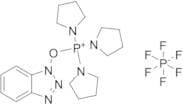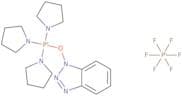
CAS 128625-52-5
:PyBOP
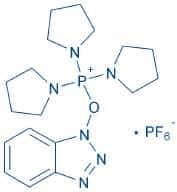
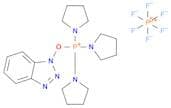
- (1-Hydroxy-1H-benzotriazolato-O)tri-1-pyrrolidinylphosphorus(1+) hexafluorophosphate(1-)
- 1-Benzotriazolyloxytripyrrolidinylphosphonium hexafluorophosphate
- 1H-Benzotriazol-1-yloxytripyrrolidinophosphonium Hexafluorophosphate
- 1H-Benzotriazole, 1-hydroxy-, phosphorus complex
- Benzotriazol-1-yl-oxytripyrrolidinophosphonium hexafluorophosphate
- Benzotriazol-1-yloxytripyrrolidinophosphonium hexafluorophosphate
- Benzotriazole-1-yl-oxytripyrrolidinophosphonium hexafluorophosphate
- Phosphorus(1+), [1-(hydroxy-κO)-1H-benzotriazolato]tri-1-pyrrolidinyl-, (T-4)-, hexafluorophosphate(1-) (1:1)
- PyBOP
- Pyrrolidine, phosphorus complex
1H-Benzotriazol-1-yloxytripyrrolidinophosphonium Hexafluorophosphate [Coupling Reagent for Peptide]
CAS:Formula:C18H28F6N6OP2Purity:>98.0%(HPLC)Color and Shape:White to Light yellow powder to crystalMolecular weight:520.401H-Benzotriazol-1-yloxytri(1-pyrrolidinyl)phosphonium hexafluorophosphate, 98%
CAS:1H-Benzotriazol-1-yloxytri(1-pyrrolidinyl) phosphonium hexafluorophosphate is a peptide coupling reagent utilized in solid phase peptide synthesis. It is also used as a substitute for the (benzotriazol-1-yloxy)tris(dimethylamino)phosphonium hexafluorophosphate (BOP) reagent. This Thermo Scientific CFormula:C18H28N6OPPurity:98%Color and Shape:White to pale cream, Crystals or powder or crystalline powderMolecular weight:375.441H-Benzotriazol-1-yloxytripyrrolidinophosphonium hexafluorophosphate
CAS:Formula:C18H28F6N6OP2Purity:98.0%Color and Shape:Solid, Powder or Crystalline Powder or Solid or ChunksMolecular weight:520.401PyBOP
CAS:A trademark of Merck KGaA, Darmstadt, Germany PyBOP is a well-established, effective coupling reagent. It has been developed to replace BOP which generates the carcinogenic HMPT as a by-product during coupling. Contrary to activation with uronium/aminium-type coupling reagents, by-products resulting from guanidinylation of the amino group cannot be formed. PyBOP has been used as well for obtaining peptide thioesters.Formula:C18H28N6OP·PF6Color and Shape:WhiteMolecular weight:520.4(Benzotriazol-1-yloxy)tripyrrolidinophosphonium hexafluorophosphate
CAS:Formula:C18H28F6N6OP2Purity:98%Color and Shape:SolidMolecular weight:520.3925Benzotriazole-1-yl-oxy-tris-pyrrolidino-phosphonium hexafluorophosphate
CAS:Formula:C18H28N6OP·PF6Purity:≥ 97.5%Color and Shape:White to off-white or slightly yellow crystalline powderMolecular weight:520.40[(1H-Benzotriazol-1-yl)oxy][tri(pyrrolidin-1-yl)]phosphonium hexafluorophosphate
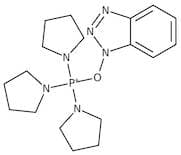
CAS:[(1H-Benzotriazol-1-yl)oxy][tri(pyrrolidin-1-yl)]phosphonium hexafluorophosphateFormula:C18H28N6OP·PF6Purity:≥95%Color and Shape: white crystalline solidMolecular weight:520.39g/molBenzotriazol-1-yl-oxytripyrrolidinphosphonium Hexafluorophosphate
CAS:Controlled ProductApplications Benzotriazol-1-yl-oxytripyrrolidinphosphonium Hexafluorophosphate (cas# 128625-52-5) is a compound useful in organic synthesis.
Formula:C18H28N6OP·F6PColor and Shape:NeatMolecular weight:520.39PyBOP
CAS:PyBOP is an acyclic nucleoside phosphonate that is structurally similar to cyclic peptides and coumarin derivatives. It has been shown to be active against infectious diseases such as malaria and hepatitis C, as well as metabolic disorders such as obesity. PyBOP also has a number of physiological effects, including thermal expansion and immunomodulation. PyBOP binds to the 3'-hydroxyl group of RNA by hydrogen bonding interactions in vivo and inhibits rRNA synthesis, leading to the inhibition of protein synthesis. This drug also disrupts the disulfide bond between cysteine residues in proteins, which may lead to autoimmune diseases. PyBOP is water-soluble and highly soluble in organic solvents, but not soluble in water or polar solvents such as DMSO or acetone. br>br> The thermal expansion coefficient for PyBOP is about 10^6 K^-1mol^
Formula:C18H28N6OP2F6Purity:Min. 95%Molecular weight:520.39 g/mol(Benzotriazol-1-yloxy)tripyrrolidinophosphonium hexafluorophosphate
CAS:PyBOP is a phosphonium salt used as a coupling reagent for peptide synthesis. PyBOP is very efficient: high yields, low epimerisation and high conversion rates can be achieved. PyBOP generates an activated HOBt ester in situ, in the presence of a base such as triethylamine or Hünig’s base. PyBOP is the pyrrolidino derivative of the phosphonium coupling reagent BOP, which is equally efficient, but generates the extremely toxic and carcinogenic HMPA as a by-product in situ. PyBOP is generally preferred over BOP because it gives comparable performances but generates a less toxic by-product.Formula:C18H28N6OP·PF6Purity:Min. 98 Area-%Color and Shape:White PowderMolecular weight:520.39 g/mol
![1H-Benzotriazol-1-yloxytripyrrolidinophosphonium Hexafluorophosphate [Coupling Reagent for Peptide]](/_next/image/?url=https%3A%2Fstatic.cymitquimica.com%2Fproducts%2F3B%2Fthumb%2FB1774.jpg&w=3840&q=75)






![[(1H-Benzotriazol-1-yl)oxy][tri(pyrrolidin-1-yl)]phosphonium hexafluorophosphate](/_next/image/?url=https%3A%2Fstatic.cymitquimica.com%2Fproducts%2F54%2Fthumb%2FPC1208.jpg&w=3840&q=75)