CAS 129477-21-0
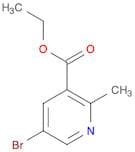
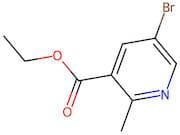
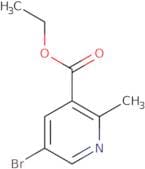
:ethyl 5-bromo-2-methylpyridine-3-carboxylate
Description:
Ethyl 5-bromo-2-methylpyridine-3-carboxylate is an organic compound characterized by its pyridine ring structure, which includes a bromine substituent and an ethyl ester functional group. The presence of the bromine atom at the 5-position of the pyridine ring contributes to its reactivity, making it a useful intermediate in various chemical syntheses. The methyl group at the 2-position and the carboxylate group at the 3-position enhance its solubility in organic solvents and influence its chemical behavior. This compound is typically used in medicinal chemistry and organic synthesis, particularly in the development of pharmaceuticals and agrochemicals. Its properties, such as boiling point, melting point, and solubility, can vary based on the specific conditions and purity of the sample. Safety precautions should be observed when handling this compound, as it may pose health risks due to the presence of bromine and its potential reactivity. Overall, ethyl 5-bromo-2-methylpyridine-3-carboxylate is a versatile compound with significant applications in chemical research and development.
Formula:C9H10BrNO2
InChI:InChI=1/C9H10BrNO2/c1-3-13-9(12)8-4-7(10)5-11-6(8)2/h4-5H,3H2,1-2H3
SMILES:CCOC(=O)c1cc(cnc1C)Br
Synonyms:- 3-Pyridinecarboxylic Acid, 5-Bromo-2-Methyl-, Ethyl Ester
- Ethyl 5-Bromo-2-Methylnicotinate
- 5-Bromo-2-methylnicotinic acid ethyl ester
Sort by
Purity (%)
0
100
|
0
|
50
|
90
|
95
|
100
Found 4 products.
3-Pyridinecarboxylic acid, 5-bromo-2-methyl-, ethyl ester
CAS:Formula:C9H10BrNO2Purity:98%Color and Shape:SolidMolecular weight:244.0852Ethyl 5-bromo-2-methylnicotinate
CAS:Ethyl 5-bromo-2-methylnicotinatePurity:97%Color and Shape:Pale Yellow SolidMolecular weight:244.09g/molEthyl 5-bromo-2-methylnicotinate
CAS:Formula:C9H10BrNO2Purity:95%Color and Shape:SolidMolecular weight:244.088Ethyl 5-bromo-2-methylnicotinate
CAS:Ethyl 5-bromo-2-methylnicotinate is a crystalline compound that is extracted from the industrial process of synthetic organic solvents. The extraction of this compound can be done using an acetylation reaction with ammonium acetate. This chemical is then recrystallized to produce a large amount of pure product. The average yield for this chemical is around 60%.
Purity:Min. 95%