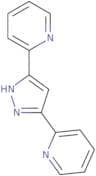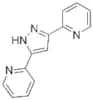
CAS 129485-83-2
:Dipyridylpyrazole; 98%
Description:
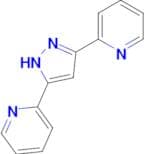
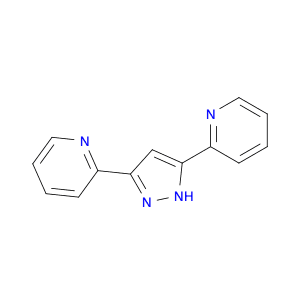
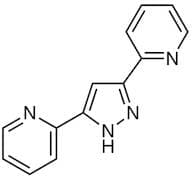
Dipyridylpyrazole, with the CAS number 129485-83-2, is a chemical compound characterized by its unique structure, which includes two pyridine rings and a pyrazole moiety. This compound typically appears as a solid and is known for its potential applications in various fields, including agriculture and materials science. It exhibits properties such as good solubility in organic solvents and stability under standard laboratory conditions. Dipyridylpyrazole is often utilized as a ligand in coordination chemistry, forming complexes with transition metals, which can enhance catalytic activity or modify electronic properties. Additionally, its derivatives may possess biological activity, making it of interest in pharmaceutical research. The "98%" designation indicates a high level of purity, which is crucial for ensuring reproducibility in experimental applications. Safety data sheets should be consulted for handling and storage guidelines, as with any chemical substance, to mitigate risks associated with exposure or environmental impact.
Formula:C13H10N4
InChI:InChI=1/C13H10N4/c1-3-7-14-10(5-1)12-9-13(17-16-12)11-6-2-4-8-15-11/h1-9H,(H,16,17)
SMILES:c1ccnc(c1)c1cc(c2ccccn2)n[nH]1
Synonyms:- 3,5-Di(2-pyridyl)pyrazole
- 2,2'-(1H-pyrazole-3,5-diyl)dipyridine
Sort by
Purity (%)
0
100
|
0
|
50
|
90
|
95
|
100
Found 5 products.
3,5-Di(2-pyridyl)pyrazole
CAS:Purity:98.0%Color and Shape:Liquid, No data available.Molecular weight:222.25100708007812Pyridine, 2,2'-(1H-pyrazole-3,5-diyl)bis-
CAS:Formula:C13H10N4Purity:98%Color and Shape:SolidMolecular weight:222.24533,5-Di(2-pyridyl)pyrazole
CAS:Formula:C13H10N4Purity:>98.0%(GC)(T)Color and Shape:White to Light yellow powder to crystalMolecular weight:222.253,5-Di(2-pyridyl)pyrazole
CAS:3,5-Di(2-pyridyl)pyrazole is a tetranuclear compound that binds to metal ions such as ruthenium and forms a coordination complex. In the presence of ancillary ligands, it can form supramolecular structures, which are assemblies of molecules that exist in a non-covalent manner. The second order rate constant for the intramolecular hydrogen transfer from 3,5-di(2-pyridyl)pyrazole to a metal ion was measured as 0.0074 M/s. This reaction is possible due to hydrogen bonding interactions between the nitrogen atoms on the pyrazole ring and the metal ion.
Formula:C13H10N4Purity:Min. 95%Color and Shape:PowderMolecular weight:222.25 g/mol