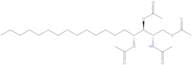
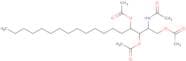
CAS 13018-48-9
:Acetamide, N-[(1S,2S,3R)-2,3-bis(acetyloxy)-1-[(acetyloxy)methyl]heptadecyl]-
Description:
Acetamide, N-[(1S,2S,3R)-2,3-bis(acetyloxy)-1-[(acetyloxy)methyl]heptadecyl]- is a complex organic compound characterized by its amide functional group and a long aliphatic chain. The presence of multiple acetyloxy groups indicates that it has ester functionalities, which can influence its solubility and reactivity. The stereochemistry denoted by the (1S,2S,3R) configuration suggests specific spatial arrangements of atoms, which can affect the compound's biological activity and interactions. This compound is likely to exhibit amphiphilic properties due to its hydrophobic alkyl chain and hydrophilic acetamide and acetyloxy groups, making it potentially useful in applications such as surfactants or emulsifiers. Additionally, the long carbon chain may contribute to its physical properties, such as melting and boiling points, as well as its behavior in biological systems. Overall, this compound's unique structure and functional groups make it a subject of interest in both synthetic chemistry and potential pharmaceutical applications.
Formula:C26H47NO7
Synonyms:- Tetraacetyl-D-ribo-Phytosphingosine
- Tetraacetylphytosphingosine >
- Tetraacetylphytosphingosine >=98% (HPLC)
- Acetamide, N-[(1S,2S,3R)-2,3-bis(acetyloxy)-1-[(acetyloxy)methyl]heptadecyl]-
Sort by
Purity (%)
0
100
|
0
|
50
|
90
|
95
|
100
Found 2 products.
Tetraacetylphytosphingosine
CAS:Tetraacetylphytosphingosine is a fatty acid that belongs to the group of polyunsaturated fatty acids. It has been shown to have anti-cancer activity in skin cells and can be used for the treatment of acne. Tetraacetylphytosphingosine is not active in the presence of amines, but it is activated by an enzyme in wheat germ called tyrosinase. This compound inhibits tyrosinase activity, which leads to reduced production of melanin. Tetraacetylphytosphingosine also reduces skin inflammation and can be used as a moisturizer. It also has an inhibitory effect on the growth of some bacteria, such as Mycobacterium tuberculosis and Mycobacterium avium complex, through its ability to bind with lipids on their cell surface.Formula:C26H47NO7Purity:Min. 95%Color and Shape:PowderMolecular weight:485.7 g/mol