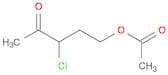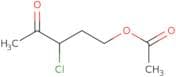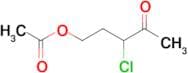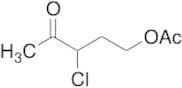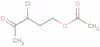
CAS 13051-49-5
:2-Chloro-3-oxopentyl acetate
- 2-Pentanone, 3-chloro-5-hydroxy-, acetate
- 2-Pentanone, 5-(acetyloxy)-3-chloro-
- 3-Chloro-3-acetopropyl acetate
- 3-Chloro-4-Oxopentyl Acetate
- 3-Chloro-5-acetoxy-2-pentanone
- 3-Chloro-5-hydroxy-2-pentanone acetate
- 5-(Acetyloxy)-3-chloro-2-pentanone
- 5-Acetoxy-3-chloro-2-pentanone
- Ai3-34640
- Brn 0971207
- 4-02-00-00299 (Beilstein Handbook Reference)
- 3-chloro-5-hydroxy-2-pentanon acetate
- 3-Chloro-5-hydroxy-2-pentanon acetate CAS NO.13051-49-5
- 3-ACETO-3-CHLORO-PROPYL ACETATE
- 5-Acetoxy-3-chloropentan-2-one
- 2-chloro-3-oxopentyl acetate
- 2-Chlor-3-oxopentylacetat
- See more synonyms
2-Pentanone, 5-(acetyloxy)-3-chloro-
CAS:Formula:C7H11ClO3Purity:95%Color and Shape:SolidMolecular weight:178.61345-Acetoxy-3-chloro-2-pentanone
CAS:5-Acetoxy-3-chloro-2-pentanone is a thioformamide that is used as an intermediate in the synthesis of vitamin B1. It is also a precursor to formic acid and formaldehyde, which are used in the production of dyes and other chemical products. 5-Acetoxy-3-chloro-2-pentanone is synthesized by reacting hydroxylamine with acetyl chloride. The reaction proceeds via a nucleophilic substitution reaction. This product has a high yield and can be produced with various alkyl groups, such as 1-4C, 2C, 3C, 4C, 5C, 6C, 7C, 8C or 9C. 5-Acetoxy-3-chloro-2-pentanone can be used to produce formic acid or formaldehyde by reacting it with sodium hydroxide or potassium hydroxide respectively.
Formula:C7H11ClO3Purity:Min. 95%Molecular weight:178.61 g/mol5-Acetoxy-3-chloro-2-pentanone
CAS:Controlled ProductApplications 5-Acetoxy-3-chloro-2-pentanone (cas# 13051-49-5) is a compound useful in organic synthesis.
Formula:C7H11ClO3Color and Shape:NeatMolecular weight:178.61