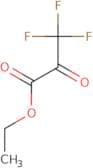
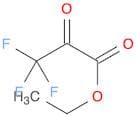
CAS 13081-18-0
:Ethyl 3,3,3-trifluoro-2-oxopropanoate
Description:
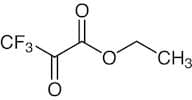
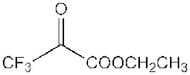
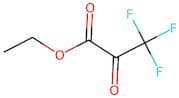
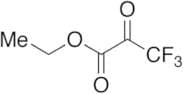
Ethyl 3,3,3-trifluoro-2-oxopropanoate, with the CAS number 13081-18-0, is an organic compound characterized by its trifluoromethyl group and ester functional group. This compound features a propanoate backbone, where the ethyl group is attached to the ester, and a ketone functionality is present at the second carbon. The presence of three fluorine atoms significantly influences its chemical properties, enhancing its reactivity and polarity compared to non-fluorinated analogs. Ethyl 3,3,3-trifluoro-2-oxopropanoate is typically a colorless liquid at room temperature and is soluble in organic solvents. It is often utilized in synthetic organic chemistry, particularly in the development of pharmaceuticals and agrochemicals, due to its ability to participate in various chemical reactions, including nucleophilic substitutions and condensation reactions. The trifluoromethyl group imparts unique electronic properties, making it a valuable building block in the synthesis of more complex fluorinated compounds. Safety precautions should be taken when handling this substance, as it may pose health risks if inhaled or ingested.
Formula:C5H5F3O3
InChI:InChI=1S/C5H5F3O3/c1-2-11-4(10)3(9)5(6,7)8/h2H2,1H3
InChI key:InChIKey=KJHQVUNUOIEYSV-UHFFFAOYSA-N
SMILES:C(C(C(F)(F)F)=O)(OCC)=O
Synonyms:- 3,3,3-Trifluoro-2-Oxopropanoic Acid Ethyl Ester
- 3,3,3-Trifluoropyruvic acid ethyl ester
- E-Tfpa
- Ethyl 2-Oxo-3,3,3-Trifluoro Propionate
- Ethyl 2-oxo-3,3,3-trifluoropropanoate
- Ethyl 3,3,3-Trifluoro-2-Oxopropanoate
- Ethyl 3,3,3-Trifluoropyruvate
- Ethyl trifluoropyruvate 98%
- Ethyltrifluoropyruvate98%
- Methyl 3,3,3-Trifluoro-2-Oxopropanoate
- Propanoic acid, 3,3,3-trifluoro-2-oxo-, ethyl ester
- Pyruvic acid, trifluoro-, ethyl ester
- Rarechem Al Bi 1300
- Trifluoropyruvic Acid Ethyl Ester
- See more synonyms
Sort by
Purity (%)
0
100
|
0
|
50
|
90
|
95
|
100
Found 8 products.
Ethyl Trifluoropyruvate
CAS:Formula:C5H5F3O3Purity:>98.0%(GC)Color and Shape:Colorless to Light yellow to Light orange clear liquidMolecular weight:170.09Ethyl trifluoropyruvate, 97%
CAS:Ethyl trifluoropyruvate acts as a building block in synthetic chemistry for the synthesis of fluorine containing compounds. It is also used as a reagent for the preparation of potential biologically active compounds like highly enantioselective organocatalytic hydroxyalkylation of indoles. This TherFormula:C5H5F3O3Purity:97%Color and Shape:Liquid, Clear colorless to pale yellowMolecular weight:170.09Ethyl trifluoropyruvate
CAS:Ethyl trifluoropyruvateFormula:C5H5F3O3Purity:98%Color and Shape: clear. colourless liquidMolecular weight:170.09g/molEthyl trifluoropyruvate
CAS:Formula:C5H5F3O3Purity:97.0%Color and Shape:LiquidMolecular weight:170.087Trifluoropyruvic Acid Ethyl Ester
CAS:Controlled ProductStability Moisture Sensitive
Applications Trifluoropyruvic Acid Ethyl Ester is used as a reagent in the preparation of potential biologically active compounds such as in the highly enantioselective organocatalytic hydroxyalkylation of indoles.
References Toeroek, B. et al.: Angew. Chem. Int. Ed., 44, 3086 (2005); Wolf, C. et al.: Adv. Synth. Cat., 353, 760 (2011);Formula:C5H5F3O3Color and Shape:NeatMolecular weight:170.09Trifluoropyruvic acid ethyl ester
CAS:Trifluoropyruvic acid ethyl ester is a synthetic compound and an enantiopure ligand for coordination chemistry. It is activated by the addition of hydroxyl groups to the molecule, which can be achieved with hydrochloric acid. Trifluoropyruvic acid ethyl ester has been shown to form stable complexes with metal ions, such as copper and zinc. This complex has been shown to bind to receptors in biological systems, including non-steroidal anti-inflammatory agents. Trifluoropyruvic acid ethyl ester binds to receptors on cell membranes by intermolecular hydrogen bonding between the phenolic hydroxyl group and the receptor's aromatic ring system, which induces conformational changes in the receptor protein that leads to its activation or inhibition.Formula:C5H5F3O3Purity:Min. 98%Color and Shape:Colorless PowderMolecular weight:170.09 g/molEthyl 3,3,3-trifluoro-2-oxopropanoate
CAS:Formula:C5H5F3O3Purity:95%Color and Shape:LiquidMolecular weight:170.0866