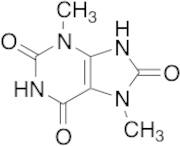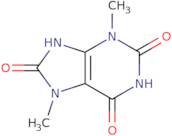
CAS 13087-49-5
:3,7-dimethyluric acid
- 1H-Purine-2,6,8(3H)-trione, 7,9-dihydro-3,7-dimethyl-
- 3,7-Dimethyl-1H-purine-2,6,8(3H,7H,9H)-trione
- 3,7-Dimethyl-2,3,6,7,8,9-hexahydro-1H-purine-2,6,8-trione
- 3,7-Dmu
- 3,7-dimethyl-7,9-dihydro-1H-purine-2,6,8(3H)-trione
- 7,9-Dihydro-3,7-dimethyl-1H-purine-2,6,8(3H)-trione
- 8-Hydroxytheobromine
- Ba 2754
- Oxytheobromine
- Uric acid, 3,7-dimethyl-
- 3,7-Dimethyluric acid
- Unii-yht75V2nae
- 3,7-dimethyl-9H-purine-2,6,8-trione
- 7-Methyl-3-methyluric Acid
- 3,7-Dimethyluric acid,3,7-Dimethyl-2,6,8-trihydroxypurine
- 3,7-Dimethyl-7H-purine-2,6,8(1H,3H,9H)-trione
- 8-Hydroxy-3,7-dimethylxanthine
- Pentoxifylline Impurity 37
- 8-Oxotheobromine
- 3,7-Dimethyluric acid >=95.0% (HPLC)
- See more synonyms
1H-Purine-2,6,8(3H)-trione, 7,9-dihydro-3,7-dimethyl-
CAS:Formula:C7H8N4O3Purity:98%Color and Shape:SolidMolecular weight:196.16343,7-Dimethyluric Acid
CAS:Controlled ProductFormula:C7H8N4O3Color and Shape:NeatMolecular weight:196.1633,7-Dimethyluric acid
CAS:Controlled Product3,7-Dimethyluric acid (3,7-DMUA) is a purine derivative that is found in the human liver. It is metabolized by p-450 enzymes to form 3,7-dihydroxypurine and 3,7-dimethylxanthine. The carbonyl group of the compound reacts with reactive oxygen species to form a reactive carbonyl intermediate. This reactive intermediate may be responsible for the formation of DNA adducts or for the generation of oxidative metabolites that are cytotoxic. 3,7-DMUA has been shown to inhibit protein synthesis in vitro and cause cancer in vivo in mice. The effect on protein synthesis may be due to its ability to inhibit cytochrome P450 enzymes. 3,7-DMUA also has an effect on body mass index (BMI), which may be due to its ability to induce apoptosis and inhibit cell proliferation by inhibiting protein synthesis.
Formula:C7H8N4O3Purity:Min. 95%Molecular weight:196.16 g/mol