CAS 1309-33-7
:Ferric hydroxide
Description:
Ferric hydroxide, with the chemical formula Fe(OH)₃ and CAS number 1309-33-7, is an inorganic compound that appears as a reddish-brown solid. It is primarily formed through the hydrolysis of ferric salts in aqueous solutions. Ferric hydroxide is insoluble in water, which makes it useful in various applications, including water treatment processes where it acts as a coagulant to remove impurities. It has a relatively low solubility product, leading to its precipitation in alkaline conditions. The compound is amphoteric, meaning it can react with both acids and bases, forming soluble complexes or salts. Ferric hydroxide is also a precursor to other iron compounds, such as iron oxides, and is utilized in the production of pigments and as a catalyst in certain chemical reactions. Additionally, it plays a role in biological systems, particularly in iron metabolism. Safety considerations include its potential to cause irritation upon contact with skin or eyes, and appropriate handling measures should be observed.
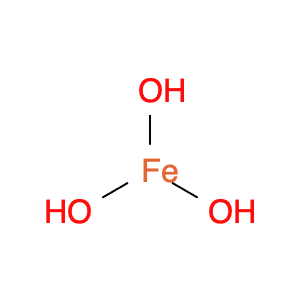
Formula:FeH3O3
InChI:InChI=1S/Fe.3H2O/h;3*1H2/q+3;;;/p-3
InChI key:InChIKey=MSNWSDPPULHLDL-UHFFFAOYSA-K
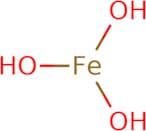
SMILES:[Fe](O)(O)O
Synonyms:- Dieisentrioxidhydrat
- Diiron Trioxide Hydrate
- Ferric hydroxide
- Ferric hydroxide gel
- Ferric trihydroxide
- Hydrated iron sesquioxide
- Hydrous iron (III) oxide
- Iron (Iii) Hydroxide
- Iron hydroxide
- Iron hydroxide (Fe(OH)<sub>3</sub>)
- Iron trihydroxide
- Iron(3+) hydroxide
- Iron(3+) trihydroxide
- Trioxido De Dihierro, Hidrato
- Trioxyde de difer, hydrate
- See more synonyms
Sort by
Purity (%)
0
100
|
0
|
50
|
90
|
95
|
100
Found 3 products.
Iron hydroxide
CAS:Iron hydroxide is a type of iron oxide, which is a chemical compound that is composed of iron and oxygen. Iron hydroxide has been shown to inhibit the growth of bacteria by binding to pyrite and other minerals in the soil. The inhibition caused by iron hydroxide is due to its ability to increase the concentration of free calcium ions in the environment and thus disrupt bacterial metabolism. Iron hydroxide can be found in dry soils, especially those with high amounts of pyrite. Iron hydroxide binds to pyrite because it has a higher affinity for it than for Ca2+. This occurs because pyrite has more surface area than Ca2+ and so more molecules are able to bind to it. Iron hydroxide can also be found in women’s urine where it inhibits the growth of bacteria such as Escherichia coli, Enterococcus faecalis, Klebsiella pneumoniae, Proteus mirabilis, PseudFormula:Fe(OH)3Color and Shape:PowderMolecular weight:106.87 g/mol