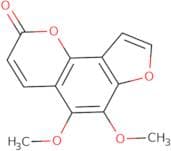
CAS 131-12-4
:Pimpinellin
Description:
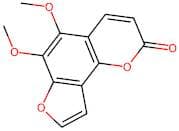
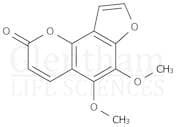
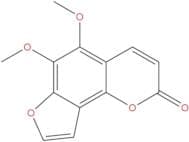
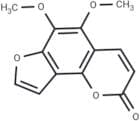
Pimpinellin, with the CAS number 131-12-4, is a naturally occurring coumarin derivative found in various plants, particularly in the Apiaceae family. It is characterized by its light yellow to brownish color and has a sweet, aromatic scent. Pimpinellin exhibits a range of biological activities, including anti-inflammatory, antioxidant, and antimicrobial properties, making it of interest in both pharmacological and cosmetic applications. The compound is soluble in organic solvents such as ethanol and ether but has limited solubility in water. Its structure features a benzopyran ring, which is typical of coumarins, contributing to its reactivity and potential interactions with biological systems. Pimpinellin is also studied for its potential role in traditional medicine and as a natural flavoring agent. However, like many natural compounds, its efficacy and safety profiles require further investigation to fully understand its therapeutic potential and any possible side effects.
Formula:C13H10O5
InChI:InChI=1S/C13H10O5/c1-15-11-7-3-4-9(14)18-10(7)8-5-6-17-12(8)13(11)16-2/h3-6H,1-2H3
InChI key:InChIKey=BQPRWZCEKZLBHL-UHFFFAOYSA-N
SMILES:O(C)C=1C2=C(C3=C(C1OC)C=CC(=O)O3)C=CO2
Synonyms:- 2H-Furo[2,3-h]-1-benzopyran-2-one, 5,6-dimethoxy-
- 5,6-Dimethoxy-2H-furo[2,3-h]-1-benzopyran-2-one
- 5,6-dimethoxy-2H-furo[2,3-h]chromen-2-one
- 5,6-dimethoxy-2H-furo[2,3-h]chromene-2-one
- 6,7-Dimethoxyangelicin
- Pimpinecilin
- Pimpinelin
- Pimpinelline
- Pimpinellin
Sort by
Purity (%)
0
100
|
0
|
50
|
90
|
95
|
100
Found 6 products.
2H-Furo[2,3-h]-1-benzopyran-2-one, 5,6-dimethoxy-
CAS:Formula:C13H10O5Purity:98%Color and Shape:SolidMolecular weight:246.2155Pimpinellin
CAS:Formula:C13H10O5Purity:≥ 98.0%Color and Shape:Off-white to yellow powderMolecular weight:246.22pimpinellin
CAS:Pimpinellin is a natural product that acts as antagonist of proteins with GABA receptor activity.
Formula:C13H10O5Purity:99.85% - ≥95%Color and Shape:SolidMolecular weight:246.22Pimpinellin
CAS:Pimpinellin is a natural furanocoumarin compound, which is a bioactive substance found primarily in certain plant species, particularly those in the Apiaceae family. It is biosynthesized through the phenylpropanoid pathway, involving the shikimic acid pathway as a precursor to aromatic amino acids, which are further modified to form coumarin structures.
Formula:C13H10O5Purity:Min. 95%Color and Shape:PowderMolecular weight:246.22 g/mol
![2H-Furo[2,3-h]-1-benzopyran-2-one, 5,6-dimethoxy-](/_next/image/?url=https%3A%2Fstatic.cymitquimica.com%2Fproducts%2FIN%2Fthumb%2FDA000VAJ.jpg&w=3840&q=75)