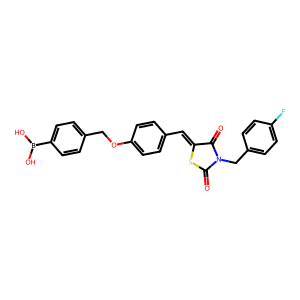
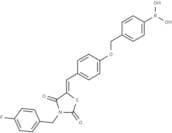
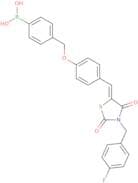
CAS 1312201-00-5
:Boronic acid, B-[4-[[4-[(Z)-[3-[(4-fluorophenyl)Methyl]-2,4-dioxo-5-thiazolidinylidene]Methyl]phenoxy]Methyl]phenyl]-
Description:
Boronic acids are a class of organic compounds characterized by the presence of a boron atom bonded to a hydroxyl group and an alkyl or aryl group. The specific compound you mentioned, with the CAS number 1312201-00-5, features a complex structure that includes multiple aromatic rings and a thiazolidinone moiety. Generally, boronic acids are known for their ability to form reversible covalent bonds with diols, making them useful in various applications, including organic synthesis and medicinal chemistry. They often exhibit properties such as moderate solubility in polar solvents, and their reactivity can be influenced by the substituents on the aromatic rings. Additionally, boronic acids can act as Lewis acids, participating in various catalytic processes. The presence of fluorine in the structure may enhance its electronic properties, potentially affecting its reactivity and interactions in biological systems. Overall, the characteristics of this specific boronic acid would be influenced by its unique molecular structure and functional groups.
Formula:C24H19BFNO5S
Synonyms:- CS-963
- B-[4-[[4-[(Z)-[3-[(4-Fluorophenyl)methyl]-2,4-dioxo-5-thiazolidinylidene]methyl]phenoxy]methyl]phenyl]-boronic acid
- HA 155
- BRWUZCBSWABPMR-XKZIYDEJSA-N
- HA155 >=98% (HPLC)
- HA155
- Boronic acid, B-[4-[[4-[(Z)-[3-[(4-fluorophenyl)Methyl]-2,4-dioxo-5-thiazolidinylidene]Methyl]phenoxy]Methyl]phenyl]-
- (Z)-4-((4-((3-(4-Fluorobenzyl)-2,4-dioxo-1,3-thiazolan-5-yliden)-methyl)phenoxy)methyl)benzeneboronic acid
- (Z)-4-((4-((3-(4-fluorobenzyl)-2,4-dioxothiazolidin-5-ylidene)methyl)phenoxy)methyl)phenylboronic acid
Sort by
Purity (%)
0
100
|
0
|
50
|
90
|
95
|
100
Found 3 products.
Z-HA155
CAS:Z-HA155 (CS-963) selectively and potently inhibits autotaxin with an IC50 of 5.7 nM.Formula:C24H19BFNO5SPurity:99.18%Color and Shape:SolidMolecular weight:463.29Ref: TM-T11533
1mg34.00€5mg71.00€1mL*10mM (DMSO)73.00€10mg101.00€25mg200.00€50mg321.00€100mg475.00€200mg680.00€HA155
CAS:HA155 is a new drug candidate for the treatment of skin cancer. It has been shown to inhibit pro-inflammatory factors, such as tumor necrosis factor (TNF) and interleukin-1β (IL-1β), that are associated with cancer growth. HA155 also inhibits the production of reactive oxygen species and the activation of nuclear factor κB in human carcinoma cells. HA155 has been shown to be effective against inflammatory diseases in mice, such as psoriasis and rheumatoid arthritis. The molecule acts by binding to adenosine receptors on immune cells, thereby inhibiting their response to inflammation.Formula:C24H19BFNO5SPurity:Min. 95%Molecular weight:463.29 g/mol