CAS 131580-10-4
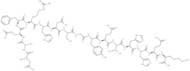
:H-Asp-Ala-Glu-Phe-Arg-His-Asp-Ser-Gly-Tyr-Glu-Val-His-His-Gln-Lys-OH
Description:
The chemical substance with the name "H-Asp-Ala-Glu-Phe-Arg-His-Asp-Ser-Gly-Tyr-Glu-Val-His-His-Gln-Lys-OH" is a peptide composed of a sequence of amino acids, specifically Aspartic acid (Asp), Alanine (Ala), Glutamic acid (Glu), Phenylalanine (Phe), Arginine (Arg), Histidine (His), Serine (Ser), Glycine (Gly), Tyrosine (Tyr), Valine (Val), Glutamine (Gln), and Lysine (Lys). This peptide is characterized by its diverse functional groups, which contribute to its solubility, reactivity, and biological activity. The presence of basic amino acids like Arg, His, and Lys suggests potential interactions with negatively charged molecules, while the aromatic residues (Phe, Tyr) may participate in hydrophobic interactions. The peptide's structure can influence its conformation and stability, impacting its biological functions, such as enzyme activity or receptor binding. The CAS number 131580-10-4 uniquely identifies this specific peptide, facilitating its recognition in chemical databases and literature. Overall, this peptide may have applications in biochemistry, pharmacology, and therapeutic development.
Formula:C84H119N27O28
Synonyms:- Beta-Amyloid (1-16)
- Daefrhdsgyevhhqk
- Amyloid Beta-Protein (1-16)
Sort by
Purity (%)
0
100
|
0
|
50
|
90
|
95
|
100
Found 5 products.
Amyloid β-Protein (1-16)
CAS:The Cu²⁺ complex of this soluble amyloid β-protein fragment showed significant oxidative activities toward the catechol-like substrate 1,2,3-trihydroxylbenzene (pyrogallol) and plasmid DNA cleavage. The N-terminal Aβ fragments Aβ1-14, Aβ1-15, and Aβ1-16 are elevated in cell media and in CSF in response to γ-secretase inhibitor treatment. The fragments can serve as biomarkers in clinical studies of the effect of such inhibitors.Formula:C84H119N27O28Purity:> 98%Color and Shape:White PowderMolecular weight:1955.03β-Amyloid (1-16)
CAS:β-Amyloid (1-16) is an amyloidogenic protein fragment with a sequence derived from β-amyloid.Formula:C84H119N27O28Purity:98%Color and Shape:SolidMolecular weight:1955.04Amyloid β-Protein (1-16)
CAS:Custom research peptide; min purity 95%. For different specs please use the Peptide Quote ToolFormula:C84H119N27O28Molecular weight:1,955 g/molAmyloid Beta-Protein (Human, 1-16)
CAS:Amyloid beta-protein (Aβ) is a peptide that is associated with Alzheimer's disease. It is a research tool for understanding the biology of Aβ. The Aβ peptide has been shown to activate a number of receptors and ion channels, including the nicotinic acetylcholine receptor, which may be due to its ability to bind to these proteins with high affinity. Amyloid beta-protein has also been shown to bind antibodies, which may be due to its ability to act as an antigen. Amyloid beta-protein inhibits the function of ion channels and can be used in pharmacological studies as a tool for understanding how this protein interacts with other proteins.Formula:C84H119N27O28Purity:Min. 95%Molecular weight:1,955 g/molAmyloid beta-Protein (1-16) trifluoroacetate salt
CAS:Amyloid beta-Protein (1-16) trifluoroacetate salt is a modified form of amyloid beta protein. It is synthesized by the modification of amino acids with trifluoroacetic acid and can be used to study the pathogenesis of Alzheimer's disease. Amyloid beta-Protein (1-16) trifluoroacetate salt has been shown to bind to β-amyloid, which is thought to be the main component of plaques in Alzheimer's disease. This binding inhibits the formation of β-amyloid aggregates, which are associated with neurotoxicity and neuronal cell death.Formula:C84H119N27O28Purity:Min. 95%Molecular weight:1,955.01 g/mol