CAS 131748-91-9
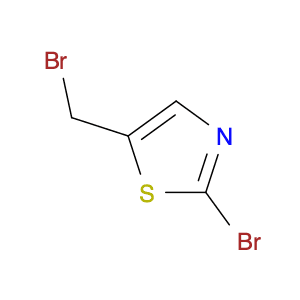
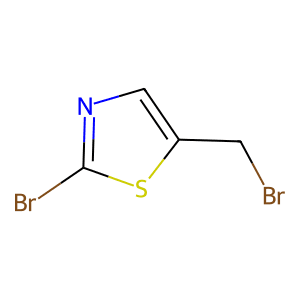
:2-Bromo-5-Bromomethyl-Thiazole
Description:
2-Bromo-5-bromomethyl-thiazole is a heterocyclic organic compound characterized by the presence of a thiazole ring, which is a five-membered ring containing both sulfur and nitrogen atoms. The compound features two bromine substituents: one at the second position and another at the fifth position of the thiazole ring, along with a bromomethyl group at the fifth position. This structure contributes to its reactivity and potential applications in various chemical syntheses. The presence of bromine atoms enhances its electrophilic character, making it useful in nucleophilic substitution reactions. Additionally, thiazole derivatives are known for their biological activity, which may include antimicrobial and antifungal properties. The compound is typically handled with care due to the toxicity associated with brominated compounds. Its solubility and stability can vary depending on the solvent and environmental conditions. Overall, 2-Bromo-5-bromomethyl-thiazole is of interest in both synthetic organic chemistry and medicinal chemistry for its potential applications.
Formula:C4H3Br2NS
Sort by
Purity (%)
0
100
|
0
|
50
|
90
|
95
|
100
Found 4 products.
2-Bromo-5-bromomethylthiazole
CAS:Formula:C4H3Br2NSPurity:97%Color and Shape:SolidMolecular weight:256.9463Ref: IN-DA000ZOR
50gTo inquire75gTo inquire100gTo inquire100mg37.00€250mg42.00€1g68.00€5g210.00€10g257.00€25g540.00€15g570.00€2-Bromo-5-Bromomethyl-Thiazole
CAS:2-Bromo-5-Bromomethyl-ThiazolePurity:98%Molecular weight:256.95g/mol2-Bromo-5-(bromomethyl)thiazole
CAS:Formula:C4H3Br2NSPurity:98%Color and Shape:SolidMolecular weight:256.942-Bromo-5-(bromomethyl)thiazole
CAS:2-Bromo-5-(bromomethyl)thiazole is an industrial chemical that belongs to the tribromide class of compounds. It is used as a solvent in organic reactions and can be prepared by reacting sodium borohydride with 2-bromothiazole. The preparation process includes recrystallization from acetonitrile and dihedral rotation with potassium carbonate and phthalimide.
2-Bromo-5-(bromomethyl)thiazole has been shown to react with fluoride ions to form a borohydride ion, which is then able to abstract a hydrogen atom from a molecule of water to produce hydrogen gas.Formula:C4H3Br2NSPurity:Min. 95%Molecular weight:256.94 g/mol