CAS 1321-74-0
:Divinylbenzene
Description:
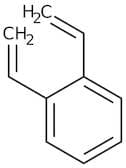
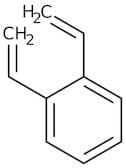
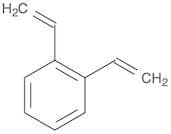
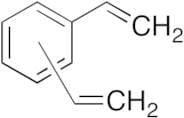
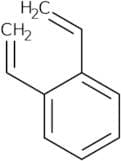
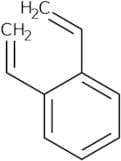
Divinylbenzene (DVB) is an organic compound characterized by its structure, which contains two vinyl groups attached to a benzene ring. It is a colorless to pale yellow liquid with a distinctive aromatic odor. DVB is known for its high reactivity due to the presence of the vinyl groups, making it a valuable monomer in the production of cross-linked polymers and resins. It is commonly used in the synthesis of ion exchange resins, as well as in the manufacture of various plastics and coatings. The compound is soluble in organic solvents but has limited solubility in water. DVB can undergo polymerization, leading to the formation of cross-linked structures that enhance the mechanical and thermal properties of the resulting materials. Safety considerations are important when handling DVB, as it can be an irritant to the skin and eyes, and appropriate precautions should be taken to minimize exposure. Overall, divinylbenzene is a versatile compound with significant applications in the chemical industry.
Formula:C10H10
InChI:InChI=1/2C10H10/c1-3-9-5-7-10(4-2)8-6-9;1-3-9-6-5-7-10(4-2)8-9/h2*3-8H,1-2H2
SMILES:C=Cc1ccc(C=C)cc1.C=Cc1cccc(C=C)c1
Synonyms:- Benzene, Divinyl
- Benzene, diethenyl-
- Diethenylbenzene
- Divinilbenceno
- Divinilbenceno, Puro
- Divinilbenzene
- Divinylbenzen
- Divinylbenzene
- Divinylbenzene Mixed Isomers
- Divinylbenzene, Mixture Of Isomers
- Divinylbenzenetechmixedisomers
- Divinylbenzol
- Dvb 810
- Dvb 96
- Dvb 960
- Dvb Hp
- Dvb-H
- Dvr 960
- Ethylvinyl Benzene
- Vinilestireno
- Vinilstirene
- Vinyl styrène
- Vinyl-Styrol
- Vinylethylbenzene
- Vinylstyren
- Vinylstyrene
- ジビニルベンゼン
- See more synonyms
Sort by
Purity (%)
0
100
|
0
|
50
|
90
|
95
|
100
Found 9 products.
Divinylbenzene (m- and p- mixture) (contains Ethylvinylbenzene, Diethylbenzene) (stabilized with TBC)
CAS:Formula:C10H10Purity:>50.0%(GC)Color and Shape:Colorless to Light orange to Yellow clear liquidMolecular weight:130.19Divinylbenzene, 80%, mixture of isomers, stab. with 1000ppm 4-tert-butylcatechol
CAS:Divinylbenzene is used as a reactive monomer in polyester resins and for the synthesis of highly crosslinked macroporous styrene as well as a crosslinking agent. It acts as an intermediate in the production of ion exchange resin. Further, it is used in making rubber, petroleum production and polymer
Formula:C10H10Purity:80%Color and Shape:Colorless to yellow, LiquidMolecular weight:130.19Divinylbenzene, 55%, mixture of isomers, stab. with 1000ppm 4-tert-butylcatechol
CAS:Crosslinking monomer
Formula:C10H10Color and Shape:LiquidMolecular weight:130.19Divinylbenzene (ortho-, meta-, or para- substituted) (~80%)
CAS:Controlled ProductApplications Divinylbenzene;m-(or p-)Divinylbenzene (cas# 1321-74-0) is a useful research chemical.
Formula:C10H10Purity:~80%Color and Shape:ColourlessMolecular weight:130.19Divinylbenzene (m- and p- mixture) (contains Ethylvinylbenzene, Diethylbenzene) - 80%
CAS:Divinylbenzene is a glycol ester that undergoes a palladium-catalyzed coupling reaction with an alkyne to produce a model system. The resulting polymer has high values of optical sensor, kinetic data, and thermal expansion. Divinylbenzene's chemical stability and particle size make it an appropriate sample preparation for various types of analytical techniques such as optical sensor, which can measure the concentration of divinylbenzene in polymers. Divinylbenzene contains nitrogen atoms that can react with fatty acids to form liver lesions in rats.Formula:C10H10Purity:Min. 80 Area-%Color and Shape:Clear LiquidMolecular weight:130.19 g/molDivinylbenzene (m- and p- mixture) (contains Ethylvinylbenzene, Diethylbenzene) - 55%
CAS:Divinylbenzene is a glycol ether that is used as a solvent and an intermediate in the production of polyvinyl chloride. It has been shown to be harmful to the liver in animal studies, causing lesions. It also causes an increase in the levels of water vapor in the air and high values for thermal expansion. Divinylbenzene undergoes a reaction with phosphorus pentoxide, yielding polyvinyl chloride and hydrogen gas. The mechanism of this reaction is catalyzed by palladium.Formula:C10H10Purity:Min. 55 Area-%Molecular weight:130.19 g/mol