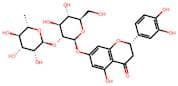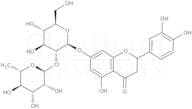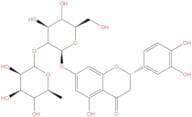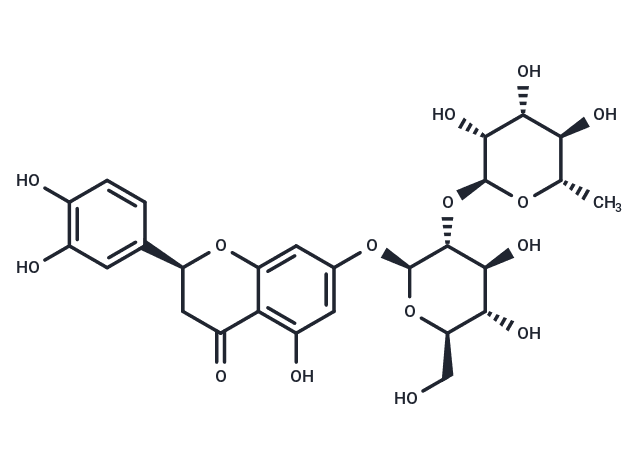
CAS 13241-32-2
:Neoeriocitrin
Description:
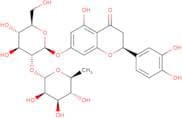
Neoeriocitrin is a flavonoid glycoside primarily found in citrus fruits, particularly in the peel and pulp of oranges and grapefruits. It is a derivative of eriocitrin, characterized by its structure that includes a flavanone backbone with a sugar moiety attached. Neoeriocitrin exhibits various biological activities, including antioxidant, anti-inflammatory, and potential neuroprotective effects, making it of interest in nutritional and pharmaceutical research. Its antioxidant properties are attributed to its ability to scavenge free radicals, which can contribute to cellular damage and various diseases. Additionally, neoeriocitrin may play a role in enhancing the bioavailability of other compounds and improving overall health. The compound is typically studied for its potential health benefits, particularly in relation to cardiovascular health and metabolic disorders. As a natural product, neoeriocitrin is considered safe for consumption, but further research is ongoing to fully understand its mechanisms of action and therapeutic potential.
Formula:C27H32O15
InChI:InChI=1S/C27H32O15/c1-9-20(33)22(35)24(37)26(38-9)42-25-23(36)21(34)18(8-28)41-27(25)39-11-5-14(31)19-15(32)7-16(40-17(19)6-11)10-2-3-12(29)13(30)4-10/h2-6,9,16,18,20-31,33-37H,7-8H2,1H3/t9-,16-,18+,20-,21+,22+,23-,24+,25+,26-,27+/m0/s1
InChI key:InChIKey=OBKKEZLIABHSGY-DOYQYKRZSA-N
SMILES:O=C1C=2C(O[C@@H](C1)C3=CC(O)=C(O)C=C3)=CC(O[C@H]4[C@H](O[C@H]5[C@H](O)[C@H](O)[C@@H](O)[C@H](C)O5)[C@@H](O)[C@H](O)[C@@H](CO)O4)=CC2O
Synonyms:- (2S)-2-(3,4-dihydroxyphenyl)-5-hydroxy-4-oxo-3,4-dihydro-2H-chromen-7-yl 2-O-(6-deoxy-alpha-L-mannopyranosyl)-beta-D-glucopyranoside
- (2S)-7-[[2-O-(6-Deoxy-α-<span class="text-smallcaps">L</smallcap>-mannopyranosyl)-β-<smallcap>D</span>-glucopyranosyl]oxy]-2-(3,4-dihydroxyphenyl)-2,3-dihydro-5-hydroxy-4H-1-benzopyran-4-one
- (S)-7-((2-O-(6-Deoxy-alpha-L-mannopyranosyl)-beta-D-glucopyranosyl)oxy)-2-(3,4-dihydroxyphenyl)-2,3-dihydro-5-hydroxy-4H-benzopyran-4-one
- 2-(3,4-dihydroxyphenyl)-5-hydroxy-4-oxo-3,4-dihydro-2H-chromen-7-yl 2-O-(6-deoxyhexopyranosyl)hexopyranoside
- 4H-1-Benzopyran-4-one, 7-[[2-O-(6-deoxy-α-<span class="text-smallcaps">L</smallcap>-mannopyranosyl)-β-<smallcap>D</span>-glucopyranosyl]oxy]-2-(3,4-dihydroxyphenyl)-2,3-dihydro-5-hydroxy-, (2S)-
- 4H-1-Benzopyran-4-one, 7-[[2-O-(6-deoxy-α-<span class="text-smallcaps">L</smallcap>-mannopyranosyl)-β-<smallcap>D</span>-glucopyranosyl]oxy]-2-(3,4-dihydroxyphenyl)-2,3-dihydro-5-hydroxy-, (S)-
- Eriodictyol 7-neohesperidoside
- Eriodictyol-7-O-neohesperidoside
- Flavanone, 3′,4′,5,7-tetrahydroxy-, 7-(2-O-α-<span class="text-smallcaps">L</smallcap>-rhamnopyranosyl-β-<smallcap>D</span>-glucopyranoside)
- Flavanone, 3′,4′,5,7-tetrahydroxy-, 7-[2-O-(6-deoxy-α-<span class="text-smallcaps">L</smallcap>-mannopyranosyl)-β-<smallcap>D</span>-glucopyranoside]
- Glucopyranoside, eriodictyol-7 2-O-(6-deoxy-α-<span class="text-smallcaps">L</smallcap>-mannopyranosyl)-, β-<smallcap>D</span>-
- Flavanone, 3′,4′,5,7-tetrahydroxy-, 7-[2-O-(6-deoxy-α-L-mannopyranosyl)-β-D-glucopyranoside]
- Glucopyranoside, eriodictyol-7 2-O-(6-deoxy-α-L-mannopyranosyl)-, β-D-
- 4H-1-Benzopyran-4-one, 7-[[2-O-(6-deoxy-α-L-mannopyranosyl)-β-D-glucopyranosyl]oxy]-2-(3,4-dihydroxyphenyl)-2,3-dihydro-5-hydroxy-, (2S)-
- Neoeriocitrin
- 4H-1-Benzopyran-4-one, 7-[[2-O-(6-deoxy-α-L-mannopyranosyl)-β-D-glucopyranosyl]oxy]-2-(3,4-dihydroxyphenyl)-2,3-dihydro-5-hydroxy-, (S)-
- See more synonyms
Sort by
Purity (%)
0
100
|
0
|
50
|
90
|
95
|
100
Found 7 products.
Neoeriocitrin
CAS:Neoeriocitrin analytical standard provided with w/w absolute assay, to be used for quantitative titration.Formula:C27H32O15Purity:(HPLC) ≥99%Color and Shape:PowderMolecular weight:596.55Neoeriocitrin
CAS:Neoeriocitrin, from Drynaria Rhizome, boosts MC3T3-E1 growth & bone differentiation; strong AChE inhibitor.Formula:C27H32O15Purity:99.92% - 99.93%Color and Shape:SolidMolecular weight:596.53Eriodictyol-7-neohesperidoside
CAS:Eriodictyol-7-neohesperidoside is a flavonoid glycoside, a type of compound that naturally occurs in certain plant species, notably within the genus Eriodictyon. This compound is a derivative of eriodictyol, which is found widely in citrus fruits. Its mode of action is primarily linked to its ability to interact with taste receptors, making it notable for its potential to modulate taste perceptions, specifically in the context of bitterness. This makes it of significant interest in the field of food science and technology.Formula:C27H32O15Purity:Min. 95%Color and Shape:PowderMolecular weight:596.53 g/mol