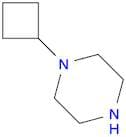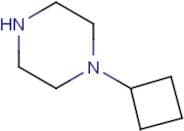
CAS 132800-13-6
:1-Cyclobutylpiperazine
Description:
1-Cyclobutylpiperazine is a chemical compound characterized by its unique bicyclic structure, which consists of a piperazine ring substituted with a cyclobutyl group. This compound typically exhibits properties associated with both cyclic amines and aliphatic hydrocarbons. It is a colorless to pale yellow liquid or solid, depending on the temperature and purity. The presence of the piperazine moiety suggests potential biological activity, as piperazine derivatives are often explored for their pharmacological properties, including anxiolytic and antidepressant effects. The cyclobutyl group can influence the compound's steric and electronic properties, potentially affecting its interaction with biological targets. Additionally, 1-Cyclobutylpiperazine may exhibit moderate solubility in organic solvents, while its solubility in water can vary. Safety data indicates that, like many amines, it should be handled with care due to potential irritant properties. Overall, 1-Cyclobutylpiperazine represents a compound of interest in medicinal chemistry and materials science, warranting further investigation into its applications and effects.
Formula:C8H16N2
InChI:InChI=1S/C8H16N2/c1-2-8(3-1)10-6-4-9-5-7-10/h8-9H,1-7H2
InChI key:InChIKey=WJJKCJYVIICABH-UHFFFAOYSA-N
SMILES:C1(CCC1)N2CCNCC2
Synonyms:- 1-Cyclobutylpiperazine
- Piperazine, 1-cyclobutyl-
- 1-Cyclobutylpiperazine 132800-13-6
- N-cyc-Bu-piperazine
Sort by
Purity (%)
0
100
|
0
|
50
|
90
|
95
|
100
Found 4 products.
1-Cyclobutylpiperazine dihydrochloride
CAS:Formula:C8H16N2Purity:97%Color and Shape:SolidMolecular weight:140.22601-Cyclobutylpiperazine
CAS:1-Cyclobutylpiperazine is a molecule with a molecular formula of C6H11N that interacts in the frequency domain. It has been shown to have conformational and vibrational frequencies as well as theoretical functions. The vibrational frequencies are determined by the molecular orbitals and the parameters of the molecule, which can be experimentally measured using devices such as sensors. The functional theory is used to describe the vibration of molecules in terms of their conformations and interactions.
Formula:C8H16N2Purity:Min. 95%Molecular weight:140.23 g/mol