CAS 1335-32-6
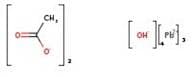
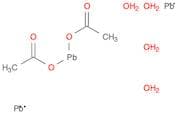
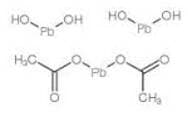
:Lead acetate (Pb3(AcO)2(OH)4)
Description:
Lead acetate, also known as lead(II) acetate, is an inorganic compound with the formula Pb(C2H3O2)2, often represented as Pb(AcO)2. It appears as a white crystalline solid and is highly soluble in water, which makes it useful in various applications, including as a reagent in laboratories and in the production of certain types of glass and ceramics. Lead acetate has a sweet taste, which historically led to its use as a sweetening agent, although this practice is now avoided due to its toxicity. The compound is classified as a lead salt and poses significant health risks, including lead poisoning, which can result from ingestion or prolonged exposure. It is also known for its ability to form complexes with other substances, making it valuable in chemical synthesis. Due to its hazardous nature, lead acetate is subject to strict regulations, and safety precautions must be taken when handling it in any setting. Its CAS number is 1335-32-6, which is used for identification in chemical databases.
Formula:C4H10O8Pb3
InChI:InChI=1/4C2H4O2.Pb/c4*1-2(3)4;/h4*1H3,(H,3,4);/q;;;;+4/p-4
SMILES:CC(=O)O.CC(=O)O.CC(=O)O.CC(=O)O.[Pb]
Synonyms:- Lead acetate (Pb<sub>3</sub>(AcO)<sub>2</sub>(OH)<sub>4</sub>)
- Lead acetate hydroxide (Pb<sub>3</sub>(OAc)<sub>2</sub>(OH)<sub>4</sub>)
- Lead acetate, basic
- Lead(4+) Tetraacetate
- Lead, bis(acetato)tetrahydroxytri-
- Lead, bis(acetato-O)tetrahydroxytri-
- Lead, bis(acetato-κO)tetrahydroxytri-
- Lead, subacetate
- Monobasic lead acetate
- Triplumbous Diacetate Tetrahydroxide
- Lead acetate (Pb3(AcO)2(OH)4)
Sort by
The purity filter is not visible because current products do not have associated purity data for filtering.
Found 4 products.
Lead(II) acetate, basic
CAS:This Thermo Scientific Chemicals brand product was originally part of the Alfa Aesar product portfolio. Some documentation and label information may refer to the legacy brand. The original Alfa Aesar product / item code or SKU reference has not changed as a part of the brand transition to Thermo SciFormula:C4H10O8Pb3Color and Shape:White, PowderMolecular weight:807.70Lead Subacetate extrapure, Pb content 33%
CAS:Formula:Pb(C2H3O2)2·2Pb(OH)2Color and Shape:White, Crystalline powderMolecular weight:807.75