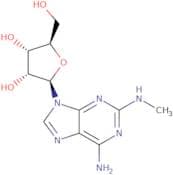
CAS 13364-95-9
:2-(methylamino)adenosine
Description:
2-(Methylamino)adenosine, with the CAS number 13364-95-9, is a purine nucleoside derivative characterized by the presence of a methylamino group at the 2-position of the adenine base. This compound is known for its role in various biochemical processes, particularly in cellular signaling and metabolism. It exhibits properties typical of nucleosides, including the ability to participate in hydrogen bonding due to its nitrogenous base, which can influence its interactions with enzymes and receptors. The methylamino substitution can affect its biological activity and solubility, making it a subject of interest in pharmacological research. Additionally, 2-(methylamino)adenosine may exhibit effects on adenosine receptors, which are implicated in numerous physiological processes, including neurotransmission and cardiovascular function. Its structural features contribute to its potential as a therapeutic agent, although further studies are necessary to fully elucidate its mechanisms of action and potential applications in medicine.
Formula:C11H16N6O4
InChI:InChI=1/C11H16N6O4/c1-13-11-15-8(12)5-9(16-11)17(3-14-5)10-7(20)6(19)4(2-18)21-10/h3-4,6-7,10,18-20H,2H2,1H3,(H3,12,13,15,16)/t4-,6-,7-,10-/m1/s1
InChI key:InChIKey=UZWXAPMSNDKDNK-KQYNXXCUSA-N
SMILES:CN=c1[nH]c(c2c(n1)n(cn2)[C@H]1[C@@H]([C@@H]([C@@H](CO)O1)O)O)N
Synonyms:- 9H-Purine, 6-amino-2-(methylamino)-9-β-<span class="text-smallcaps">D</span>-ribofuranosyl-
- 9H-purine, 6-amino-2-(methylamino)-9-beta-d-ribofuranosyl-
- Adenosine, 2-(methylamino)-
- NSC 36898
- 2-(Methylamino)adenosine
- 6-Amino-2-(methylamino)-9-beta-D-ribofuranosyl-9H-purine
Sort by
Purity (%)
0
100
|
0
|
50
|
90
|
95
|
100
Found 3 products.
2-Methylaminoadenosine
CAS:2-Methylaminoadenosine is a nucleoside that is the product of the action of adenosine deaminase on 2-aminoadenosine. It is used in diagnostic assays to differentiate between n6-methyladenosine and deoxyadenosine in DNA, RNA, or serum samples. It has been shown to have an interaction with fatty acids and their derivatives and sequences in tissues. In addition, it has been shown to have specificities for cardiac tissue and a flow rate that is constant.Formula:C11H16N6O4Purity:Min. 95%Molecular weight:296.28 g/mol