CAS 133950-71-7
:5-Bromo-1H-indol-3-yl decanoate
Description:
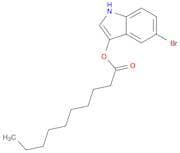
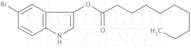
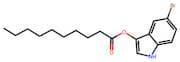
5-Bromo-1H-indol-3-yl decanoate is a chemical compound characterized by its indole structure, which is a bicyclic compound consisting of a benzene ring fused to a pyrrole ring. The presence of a bromine atom at the 5-position of the indole ring contributes to its reactivity and potential biological activity. The decanoate moiety, derived from decanoic acid, indicates that this compound is an ester, which can influence its solubility and lipophilicity. This compound may exhibit properties relevant to medicinal chemistry, particularly in the context of drug design and development, due to the indole's prevalence in various bioactive molecules. Additionally, the bromine substitution can enhance the compound's pharmacological profile by modulating interactions with biological targets. Its CAS number, 133950-71-7, allows for precise identification in chemical databases and literature. Overall, 5-Bromo-1H-indol-3-yl decanoate is of interest for its potential applications in pharmaceuticals and biochemistry.
Formula:C18H24BrNO2
InChI:InChI=1S/C18H24BrNO2/c1-2-3-4-5-6-7-8-9-18(21)22-17-13-20-16-11-10-14(19)12-15(16)17/h10-13,20H,2-9H2,1H3
InChI key:InChIKey=MSQDUIOYSURQKS-UHFFFAOYSA-N
SMILES:O(C(CCCCCCCCC)=O)C=1C=2C(NC1)=CC=C(Br)C2
Synonyms:- 5-bromo-1H-indol-3-yl decanoate
- Blue-caprate
- Decanoic acid, 5-bromo-1H-indol-3-yl ester
Sort by
Purity (%)
0
100
|
0
|
50
|
90
|
95
|
100
Found 4 products.
5-Bromo-3-indolyl decanoate
CAS:5-Bromo-3-indolyl decanoate (BID) is a chromogenic enzyme substrate often used for the detection of lipase activity. It is hydrolyzed by lipase to produce a blue-violet product, which can be detected visually or by spectrophotometry. BID is particularly useful for the detection of microbial lipases in food and environmental samples. It is commonly used in a wide range of biochemical, biological, and environmental testing applications that require precise lipase enzyme analysis.Formula:C18H24BrNO2Purity:Min. 95%Color and Shape:PowderMolecular weight:366.29 g/mol