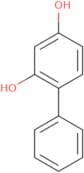
CAS 134-52-1
:4-Phenylresorcinol
Description:
4-Phenylresorcinol, with the CAS number 134-52-1, is an organic compound characterized by its phenolic structure, which includes a hydroxyl group (-OH) attached to a benzene ring. This compound appears as a white to pale yellow crystalline solid and is known for its antioxidant and antimicrobial properties. It is soluble in organic solvents such as ethanol and acetone but has limited solubility in water. 4-Phenylresorcinol is often utilized in various applications, including cosmetics and personal care products, due to its skin-lightening effects and potential use as a preservative. Additionally, it has been studied for its role in the synthesis of other chemical compounds and its potential therapeutic applications. Safety data indicates that while it can be effective in low concentrations, it should be handled with care to avoid skin irritation or allergic reactions. Overall, 4-Phenylresorcinol is a versatile compound with significant relevance in both industrial and pharmaceutical contexts.
Formula:C12H10O2
InChI:InChI=1S/C12H10O2/c13-10-6-7-11(12(14)8-10)9-4-2-1-3-5-9/h1-8,13-14H
InChI key:InChIKey=LYXCJGJSIWFKHZ-UHFFFAOYSA-N
SMILES:OC1=C(C2=CC=CC=C2)C=CC(O)=C1
Synonyms:- [1,1′-Biphenyl]-2,4-diol
- 2,4-Biphenyldiol
- 4-Phenylresorcinol
- 1,3-Benzenediol, 4-phenyl-
- Resorcinol, 4-phenyl-
Sort by
Purity (%)
0
100
|
0
|
50
|
90
|
95
|
100
Found 4 products.
[1,1'-Biphenyl]-2,4-diol
CAS:Formula:C12H10O2Purity:97%Color and Shape:SolidMolecular weight:186.20664-phenylbenzene-1,3-diol
CAS:4-Phenylbenzene-1,3-diol is a hydroxy compound that is used as a precursor in the synthesis of polycarbonate. It can also be used to produce copolymers with dihydroxy compounds. 4-Phenylbenzene-1,3-diol is activated with carbonyl chloride and then reacted with a dihydroxy compound to form an ester linkage. The product can be purified by recrystallization or sublimation. 4-Phenylbenzene-1,3-diol is produced from phenol by chlorination followed by oxidation. It has been shown to have antimicrobial properties against Gram positive bacteria and fungi such as Candida albicans and Aspergillus niger. This chemical may also be used to produce polyimides, which are polymers that have high thermal stability and resistance to chemicals.Formula:C12H10O2Purity:Min. 95%Molecular weight:186.2 g/mol
![[1,1'-Biphenyl]-2,4-diol](/_next/image/?url=https%3A%2Fstatic.cymitquimica.com%2Fproducts%2FIN%2Fthumb%2FDA009YPG.jpg&w=3840&q=75)

![[1,1'-Biphenyl]-2,4-diol](/_next/image/?url=https%3A%2Fstatic.cymitquimica.com%2Fproducts%2F54%2Fthumb%2FOR1038696.jpg&w=3840&q=75)

![[1,1′-Biphenyl]-2,4-diol](/_next/image/?url=https%3A%2Fstatic.cymitquimica.com%2Fproducts%2F10%2Fthumb%2FF054406.jpg&w=3840&q=75)