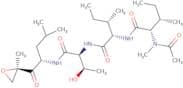
CAS 134381-21-8
:Epoxomicin
Description:
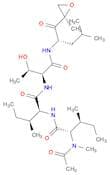
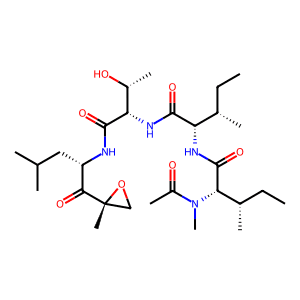
Epoxomicin is a potent and selective proteasome inhibitor, primarily known for its role in research related to cancer and neurodegenerative diseases. It is a natural product derived from the fermentation of the bacterium *Streptomyces* species. The compound features a unique epoxide functional group, which contributes to its mechanism of action by covalently binding to the active site of the proteasome, thereby inhibiting its function. This inhibition leads to the accumulation of regulatory proteins and apoptosis in cancer cells, making it a valuable tool in cancer research. Epoxomicin has also been studied for its potential neuroprotective effects, as it may influence the degradation of misfolded proteins associated with neurodegenerative disorders. In terms of physical properties, Epoxomicin is typically characterized by its solid state at room temperature and is soluble in organic solvents. Its use in laboratory settings requires careful handling due to its biological activity and potential toxicity. Overall, Epoxomicin serves as an important compound in the study of proteasome function and its implications in various diseases.
Formula:C28H50N4O7
InChI:InChI=1/C28H50N4O7/c1-11-16(5)21(30-27(38)23(17(6)12-2)32(10)19(8)34)25(36)31-26(37)22(18(7)33)29-20(13-15(3)4)24(35)28(9)14-39-28/h15-18,20-23,29,33H,11-14H2,1-10H3,(H,30,38)(H,31,36,37)/t16-,17-,18+,20?,21-,22-,23-,28+/m0/s1
InChI key:InChIKey=DOGIDQKFVLKMLQ-JTHVHQAWSA-N
SMILES:C([C@@H](NC([C@@H](NC([C@@H](NC([C@@H](N(C(C)=O)C)[C@H](CC)C)=O)[C@H](CC)C)=O)[C@@H](C)O)=O)CC(C)C)(=O)[C@@]1(C)CO1
Synonyms:- (2R)-2-[Acetyl-(N-Methyl-L-Isoleucyl)-L-Isoleucyl-L-Threonyl-L-Leucyl]-2-Methyloxirane
- <span class="text-smallcaps">L</smallcap>-Threoninamide, N-acetyl-N-methyl-<smallcap>L</smallcap>-isoleucyl-<smallcap>L</span>-isoleucyl-N-[(1S)-3-methyl-1-[[(2R)-2-methyl-2-oxiranyl]carbonyl]butyl]-
- <span class="text-smallcaps">L</smallcap>-Threoninamide, N-acetyl-N-methyl-<smallcap>L</smallcap>-isoleucyl-<smallcap>L</span>-isoleucyl-N-[(1S)-3-methyl-1-[[(2R)-2-methyloxiranyl]carbonyl]butyl]-
- Bu-4061T
- Epoxomicin, Synthetic
- N-Acetyl-N-Methyl-L-Isoleucyl-L-Isoleucyl-N-[(1S)-3-Methyl-1-[[(2R)-2-Methyloxiranyl]Carbonyl]Butyl]-L-Threoninamide
- N-Acetyl-N-methyl-<span class="text-smallcaps">L</smallcap>-isoleucyl-<smallcap>L</smallcap>-isoleucyl-N-[(1S)-3-methyl-1-[[(2R)-2-methyl-2-oxiranyl]carbonyl]butyl]-<smallcap>L</span>-threoninamide
- N-acetyl-N-methyl-L-isoleucyl-L-isoleucyl-L-threonyl-N-{2-[(2R)-2-methyloxiran-2-yl]-2-oxoethyl}-L-leucinamide
- N-acetyl-N-methyl-L-isoleucyl-N-{(2S,3R)-3-hydroxy-2-[(3-methyl-1-{[(2R)-2-methyloxiran-2-yl]carbonyl}butyl)amino]butanoyl}-L-isoleucinamide
- N-Acetyl-N-methyl-L-isoleucyl-L-isoleucyl-N-[(1S)-3-methyl-1-[[(2R)-2-methyl-2-oxiranyl]carbonyl]butyl]-L-threoninamide
- L-Threoninamide, N-acetyl-N-methyl-L-isoleucyl-L-isoleucyl-N-[(1S)-3-methyl-1-[[(2R)-2-methyloxiranyl]carbonyl]butyl]-
- L-Threoninamide, N-acetyl-N-methyl-L-isoleucyl-L-isoleucyl-N-[(1S)-3-methyl-1-[[(2R)-2-methyl-2-oxiranyl]carbonyl]butyl]-
- Epoxomicin
- Epoxomicin(BU-4061T)
- Aids010837
- CS-1626
- Aids-010837
- Epoxomicin, 97%, a selective proteasome inhibitor
- BU-4061T,Aids010837
- (2S,3S)-2-[[(2S,3S)-2-[acetyl(Methyl)aMino]-3-Methylpentanoyl]aMino]-N-[(2S,3R)-3-hydroxy-2-[[(2S)-4-Methyl-1-[(2R)-2-Methyloxiran-2-yl]-1-oxopentan-2-yl]aMino]butanoyl]-3-MethylpentanaMide
- EPOXOMICIN;BU4061T;BU-4061T
- 134381-21-8 supplier in China
- See more synonyms
Sort by
Purity (%)
0
100
|
0
|
50
|
90
|
95
|
100
Found 6 products.
Epoxomicin
CAS:Formula:C28H50N4O7Purity:≥ 98.0%Color and Shape:White to off-white or light-yellow solidMolecular weight:554.7Epoxomicin
CAS:Epoxomicin, a selective proteasome inhibitor, chiefly blocks CH-L activity, mildly affecting T-L and PGPH at lower rates.Formula:C28H50N4O7Purity:98.65% - 98.86%Color and Shape:White To Off-White SolidMolecular weight:554.72Ref: TM-T6830
1mg125.00€5mg311.00€1mL*10mM (DMSO)375.00€10mg502.00€25mg817.00€50mg1,130.00€100mg1,501.00€500mg3,022.00€Epoxomicin
CAS:Epoxomicin is an activator that binds to the ligand-binding site of a receptor. It has been used as a research tool in cell biology, pharmacology, and immunology. Epoxomicin has been shown to inhibit ion channels by binding to them and blocking their activity. This property makes epoxomicin a good candidate for the treatment of epilepsy. Epoxomicin also inhibits protein synthesis through inhibition of ribosomal S6 kinase, which is involved in signal transduction pathways.
Formula:C28H50N4O7Purity:Min. 95%Molecular weight:554.72 g/molEpoxomicin
CAS:Epoxomicin is a macrolide antibiotic that inhibits the production of inflammatory mediators by suppressing the activity of protein kinase C. Epoxomicin has been shown to have anti-inflammatory properties in low doses. This drug also inhibits the proteasome, an enzyme that breaks down proteins into amino acids or small peptides, and is used as an inhibitor of cancer cell proliferation. Epoxomicin binds to the 20S proteasome at a site that is distinct from that for other proteasome inhibitors such as lactacystin and bortezomib, which are used for cancer treatment. The binding site for epoxomicin is adjacent to the ATP-binding site and may be due to its inhibitory effect on ATP hydrolysis.Formula:C28H50N4O7Purity:Min. 95%Color and Shape:PowderMolecular weight:554.72 g/mol