CAS 13443-58-8
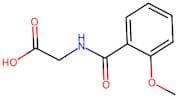
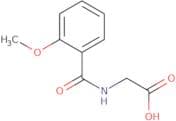
:(2-METHOXY-BENZOYLAMINO)-ACETIC ACID
Description:
(2-Methoxy-benzoylamino)-acetic acid, with the CAS number 13443-58-8, is an organic compound characterized by its functional groups, which include a methoxy group, an amide linkage, and a carboxylic acid. This compound typically appears as a white to off-white solid and is soluble in polar solvents due to the presence of the carboxylic acid group. Its structure suggests potential applications in pharmaceuticals, particularly as an intermediate in the synthesis of biologically active molecules. The methoxy group can influence the compound's lipophilicity and reactivity, while the benzoylamino moiety may enhance its interaction with biological targets. Additionally, the presence of the acetic acid component may contribute to its acidity and potential for forming salts. Overall, this compound's unique structural features make it of interest in medicinal chemistry and related fields, although specific reactivity and stability characteristics would depend on the conditions under which it is used.
Formula:C10H10NO4
InChI:InChI=1/C10H11NO4/c1-15-8-5-3-2-4-7(8)10(14)11-6-9(12)13/h2-5H,6H2,1H3,(H,11,14)(H,12,13)/p-1
SMILES:COc1ccccc1C(=NCC(=O)[O-])O
Synonyms:- N-(2-methoxybenzoyl)glycine
- {[(2-Methoxyphenyl)Carbonyl]Amino}Acetate
Sort by
Purity (%)
0
100
|
0
|
50
|
90
|
95
|
100
Found 2 products.
2-(2-Methoxybenzamido)acetic acid
CAS:2-(2-Methoxybenzamido)acetic acidPurity:95%Molecular weight:209.2g/mol(2-Methoxy-benzoylamino)-acetic acid
CAS:(2-Methoxy-benzoylamino)-acetic acid is an endogenous metabolite of the drug 2-methoxybenzoic acid. This metabolite is formed in the human liver by oxidation of the benzoic acid moiety at the 2-position, and is found in human urine samples. (2-Methoxy-benzoylamino)-acetic acid has been shown to be a major urinary metabolite of 2-methoxybenzoic acid in humans. The metabolism of this substance has been studied using incubations with rat and human liver microsomes. The metabolites formed were identified by liquid chromatography, and those that could not be identified were characterized by mass spectrometry or nuclear magnetic resonance spectroscopy. The structures of these metabolites were determined using chemical degradation methods, such as gas chromatography/mass spectrometry (GC/MS) or high performance liquid chromatography/mass spectrometry (HPLC/Formula:C10H11NO4Purity:Min. 95%Molecular weight:209.2 g/mol