CAS 13509-19-8
:Nitropicolinicacid
Description:
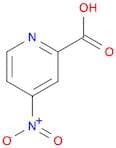
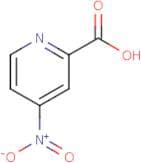
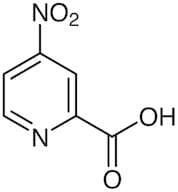
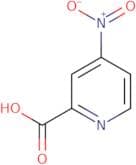
Nitropicolinic acid, with the CAS number 13509-19-8, is an organic compound that belongs to the class of picolinic acids, which are derivatives of pyridine. This compound features a nitro group (-NO2) attached to the pyridine ring, which contributes to its chemical reactivity and potential applications. It is typically characterized by its crystalline solid form and exhibits properties such as solubility in polar solvents. Nitropicolinic acid is of interest in various fields, including pharmaceuticals and materials science, due to its ability to form coordination complexes with metal ions. The presence of both carboxylic acid and nitro functional groups allows for diverse chemical reactivity, making it a valuable intermediate in organic synthesis. Additionally, its structural features may impart specific biological activities, warranting further investigation in medicinal chemistry. As with many nitro compounds, care should be taken regarding its handling and storage due to potential hazards associated with nitro functional groups.
Formula:C6H4N2O4
InChI:InChI=1/C6H4N2O4/c9-6(10)5-3-4(8(11)12)1-2-7-5/h1-3H,(H,9,10)
SMILES:c1cnc(cc1N(=O)=O)C(=O)O
Synonyms:- 4-Nitro-2-pyridinecarboxylic acid
- 4-Nitropicolinic acid
- 4-Nitropyridine-2-Carboxylic Acid
Sort by
Purity (%)
0
100
|
0
|
50
|
90
|
95
|
100
Found 5 products.
4-Nitropyridine-2-carboxylic acid
CAS:4-Nitropyridine-2-carboxylic acidPurity:98%Molecular weight:168.11g/mol4-Nitropyridine-2-carboxylic Acid
CAS:Formula:C6H4N2O4Purity:>98.0%(GC)(T)Color and Shape:White to Orange to Green powder to crystalMolecular weight:168.114-Nitropyridine-2-carboxylic acid
CAS:4-Nitropyridine-2-carboxylic acid (4NPCA) is a nitro compound that can form both an n-oxide and a deuterium isotope effect. 4NPCA has been shown to react with picolinic acid, forming a stable chelate ligand that is stabilized by the electron withdrawal of the nitro group. 4NPCA also reacts with acetonitrile to form isotopomers, which are molecules that differ only in the number of atoms of hydrogen or deuterium present. The formation of these isotopomers occurs through an intramolecular hydrogen transfer from the hydroxyl group on one molecule to the nitro group on another.Formula:C6H4N2O4Purity:Min. 95%Color and Shape:Pale yellow solid.Molecular weight:168.11 g/mol