CAS 13566-71-7
:4,6-Dihydroxy-2-phenylpyrimidine
Description:
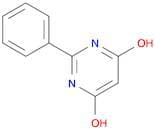
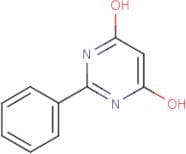
4,6-Dihydroxy-2-phenylpyrimidine is an organic compound characterized by its pyrimidine ring structure, which features two hydroxyl (-OH) groups at the 4 and 6 positions and a phenyl group at the 2 position. This compound is typically a white to off-white crystalline solid, exhibiting moderate solubility in polar solvents due to the presence of hydroxyl groups that can engage in hydrogen bonding. Its molecular structure suggests potential applications in pharmaceuticals and biochemistry, particularly as a building block for various bioactive molecules. The hydroxyl groups contribute to its reactivity, allowing for further chemical modifications. Additionally, the phenyl group may enhance its lipophilicity, influencing its interaction with biological systems. As with many organic compounds, handling should be done with care, considering potential toxicity and environmental impact. Overall, 4,6-Dihydroxy-2-phenylpyrimidine is of interest in research contexts, particularly in the development of therapeutic agents or as a reagent in organic synthesis.
Formula:C10H8N2O2
InChI:InChI=1/C10H8N2O2/c13-8-6-9(14)12-10(11-8)7-4-2-1-3-5-7/h1-6H,(H2,11,12,13,14)
SMILES:c1ccc(cc1)c1nc(cc(n1)O)O
Synonyms:- 2-Phenyl-4,6-pyrimidinediol
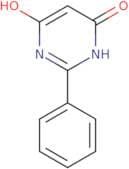
- 6-hydroxy-2-phenylpyrimidin-4(3H)-one
Sort by
Purity (%)
0
100
|
0
|
50
|
90
|
95
|
100
Found 5 products.
2-Phenyl-4,6-pyrimidinediol
CAS:Formula:C10H8N2O2Purity:95%Color and Shape:SolidMolecular weight:188.18274,6-Dihydroxy-2-phenylpyrimidine
CAS:4,6-Dihydroxy-2-phenylpyrimidinePurity:98%Molecular weight:188.18g/mol2-Phenyl-pyrimidine-4,6-diol
CAS:Formula:C10H8N2O2Purity:95.0%Color and Shape:Liquid, No data available.Molecular weight:188.1862-Phenylpyrimidine-4,6-diol
CAS:2-Phenylpyrimidine-4,6-diol is a small molecule that belongs to the class of allosteric enhancers. It is synthesized by reacting 2-phenylpyrimidine with 4,6-dihydroxybenzoic acid in the presence of a base. It has been shown to bind to adenosine receptors and act as an antagonist at both A2A and A3 receptors, as well as having inhibitory properties on the A2A receptor. Allosteric modulators such as this drug are thought to be potential treatments for neurological disorders such as Alzheimer's disease or Parkinson's disease.Formula:C10H8N2O2Purity:Min. 95%Molecular weight:188.18 g/mol