CAS 1360-76-5
:Ranaconitine
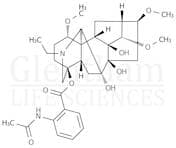
- (1Alpha,10Alpha,13Alpha,14Alpha,16Beta,17Xi)-20-Ethyl-7,8,9-Trihydroxy-1,14,16-Trimethoxyaconitan-4-Yl 2-(Acetylamino)Benzoate
- (1Alpha,14Alpha,16Beta)-20-Ethyl-7,8,9-Trihydroxy-1,14,16-Trimethoxyaconitan-4-Yl 2-(Acetylamino)Benzoate
- 2H-12,3,6a-Ethanylylidene-7,9-methanonaphth[2,3-b]azocine, aconitane-4,7,8,9-tetrol deriv.
- 7-Hydroxylappaconitine
- Aconitane-4,7,8,9-tetrol, 20-ethyl-1,14,16-trimethoxy-, 4-(2-(acetylamino)benzoate), (1alpha,14alpha,16beta)-
- Aconitane-4,7,8,9-tetrol, 20-ethyl-1,14,16-trimethoxy-, 4-[2-(acetylamino)benzoate], (1α,14α,16β)-
- Ranaconitine
ranaconitine
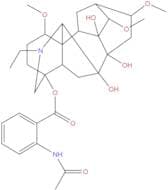
CAS:Ranaconitine is an important diterpenoid alkaloid from Aconitum sinomontanum Nakai,ranaconitine has cardiotoxicity.Formula:C32H44N2O9Purity:98% - 99.02%Color and Shape:SolidMolecular weight:600.7Ref: TM-T5765
1mg37.00€5mg77.00€10mg99.00€25mg167.00€50mg239.00€100mg354.00€200mg505.00€1mL*10mM (DMSO)86.00€Ranaconitine (>90%)
CAS:Controlled ProductApplications Ranaconitine is an important diterpenoid alkaloid from Aconitum sinomontanum and displayspotential anti-inflammatory analgesic activity as well as antagonism and modulation of voltage-gated Na+ channels.
Not a dangerous good if item is equal to or less than 1g/ml and there is less than 100g/ml in the package
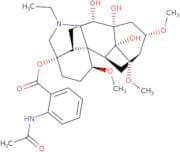
References Mericli, A. et al.: Helv. Chim. Acta., 95, 314 (2012); Turabekova, M. et al.: Compu. Biol. Chem., 32, 88 (2008);Formula:C32H44N2O9Purity:>90%Color and Shape:NeatMolecular weight:600.7Ranaconitine
CAS:Controlled ProductRanaconitine is a diterpenoid alkaloid that can be found in the plants Ranunculus, Isolappula and Aconitum. It has been shown to have an uptake of 0.5-2 µg/cm2/min when applied topically to the skin of mice. Ranaconitine has also been shown to inhibit the growth of bacteria by binding to bacterial DNA gyrase and topoisomerase IV, preventing its replication and transcription. This anti-bacterial activity is reversible and not bactericidal. Ranaconitine has also been shown to have a concentration-time curve with a peak at 2 hours after application on the skin and a plateau between 8-24 hours. The mechanism studies showed that ranaconitine inhibits calcium ion transport through the cell membrane, which leads to inhibition of intracellular ATP production in bacteria.
Formula:C32H44N2O9Purity:Min. 95%Molecular weight:600.7 g/mol