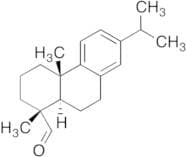
CAS 13601-88-2
:Dehydroabietal
Description:
Dehydroabietal is a chemical compound derived from abietic acid, which is a natural resin acid found in pine tree resins. It is characterized by its structure as a bicyclic compound with a fused ring system, featuring multiple double bonds that contribute to its reactivity. Dehydroabietal is typically a solid at room temperature and is known for its hydrophobic properties, making it insoluble in water but soluble in organic solvents. This compound exhibits significant biological activity, including antimicrobial and anti-inflammatory properties, which have garnered interest in pharmaceutical applications. Additionally, dehydroabietal can undergo various chemical transformations, making it a valuable intermediate in organic synthesis. Its applications extend to the production of resins, adhesives, and coatings, where it can enhance the performance characteristics of the final products. Overall, dehydroabietal is an important compound in both natural product chemistry and industrial applications, reflecting its versatility and utility in various fields.
Formula:C20H28O
InChI:InChI=1S/C20H28O/c1-14(2)15-6-8-17-16(12-15)7-9-18-19(3,13-21)10-5-11-20(17,18)4/h6,8,12-14,18H,5,7,9-11H2,1-4H3/t18-,19-,20+/m0/s1
InChI key:InChIKey=YCLCHPWRGSDZKL-SLFFLAALSA-N
SMILES:C[C@@]12C=3C(CC[C@]1([C@@](C=O)(C)CCC2)[H])=CC(C(C)C)=CC3
Synonyms:- Abietaldehyde, dehydro-
- Podocarpa-8,11,13-trien-15-al, 13-isopropyl-
- (1R,4aS,10aR)-1,2,3,4,4a,9,10,10a-Octahydro-1,4a-dimethyl-7-(1-methylethyl)-1-phenanthrenecarboxaldehyde
- 1-Phenanthrenecarboxaldehyde, 1,2,3,4,4a,9,10,10a-octahydro-1,4a-dimethyl-7-(1-methylethyl)-, [1R-(1α,4aβ,10aα)]-
- 1-Phenanthrenecarboxaldehyde, 1,2,3,4,4a,9,10,10a-octahydro-1,4a-dimethyl-7-(1-methylethyl)-, (1R,4aS,10aR)-
Sort by
The purity filter is not visible because current products do not have associated purity data for filtering.
Found 3 products.
Dehydroabietal
CAS:Controlled ProductApplications Dehydroabietal is an essential oil and found in the composition of seed extractives from various Abies and Picea species.
Not a dangerous good if item is equal to or less than 1g/ml and there is less than 100g/ml in the package
References Falsca, A., et al.: Biochem. Syst. Ecol., 69, 166-175 (2016); Wajs-Bonikowska, A., et al.: Chem. Biodivers., 13, 1194-1201 (2016)Formula:C20H28OColor and Shape:NeatMolecular weight:284.44