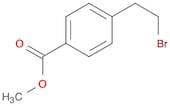
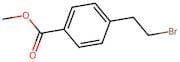
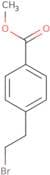
CAS 136333-97-6
:Benzoic acid, 4-(2-bromoethyl)-, methyl ester
Description:
Benzoic acid, 4-(2-bromoethyl)-, methyl ester, with the CAS number 136333-97-6, is an organic compound that features a benzoic acid moiety substituted with a bromoethyl group at the para position and a methyl ester functional group. This compound is characterized by its aromatic ring, which contributes to its stability and reactivity. The presence of the bromoethyl group introduces a halogen, which can participate in nucleophilic substitution reactions, making it a potential intermediate in organic synthesis. The methyl ester functional group enhances its solubility in organic solvents and can undergo hydrolysis to yield the corresponding acid. Additionally, the compound may exhibit biological activity, as many derivatives of benzoic acid are known for their antimicrobial and antifungal properties. Its physical properties, such as melting point, boiling point, and solubility, would typically depend on the specific molecular interactions and the presence of functional groups. Overall, this compound is of interest in both synthetic organic chemistry and potential pharmaceutical applications.
Formula:C10H11BrO2
Synonyms:- Methyl 4-(2-Bromoethyl)Benzoate
Sort by
Purity (%)
0
100
|
0
|
50
|
90
|
95
|
100
Found 4 products.
Benzoic acid, 4-(2-bromoethyl)-, methyl ester
CAS:Formula:C10H11BrO2Purity:95%Color and Shape:LiquidMolecular weight:243.0971Methyl 4-(2-bromoethyl)benzoate
CAS:Methyl 4-(2-bromoethyl)benzoatePurity:97%Molecular weight:243.10g/molMethyl 4-(2-Bromoethyl)benzoate
CAS:Formula:C10H11BrO2Purity:95%Color and Shape:SolidMolecular weight:243.1Methyl 4-(2-Bromoethyl)benzoate
CAS:Methyl 4-(2-bromoethyl)benzoate is a potent HDAC6 inhibitor. It has been shown to inhibit cancer cell growth and induce apoptosis in vitro and in vivo. Methyl 4-(2-Bromoethyl)benzoate is also an anti-cancer agent that inhibits the histone deacetylase enzyme, which then prevents the transcription of genes involved in cancer development. In addition, this agent inhibits the production of prostaglandin E2, which may contribute to its anti-cancer activity. The most common side effects are nausea and vomiting.Formula:C10H11BrO2Purity:Min. 95%Molecular weight:243.1 g/mol