


CAS 13637-37-1
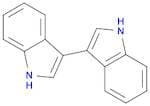
:1H,1'H-3,3'-biindole
Description:
1H,1'H-3,3'-biindole, with the CAS number 13637-37-1, is a bicyclic compound that features two indole units linked by a single bond. This structure imparts unique properties, including potential applications in organic electronics and materials science due to its conjugated system, which can facilitate charge transport. The compound exhibits interesting photophysical properties, making it a candidate for use in light-emitting devices and organic photovoltaics. Additionally, 1H,1'H-3,3'-biindole may demonstrate biological activity, as indole derivatives are known for their roles in various biochemical processes. Its solubility and stability can vary depending on the solvent and environmental conditions, which is crucial for its practical applications. The compound's synthesis typically involves multi-step organic reactions, and its characterization can be performed using techniques such as NMR spectroscopy and mass spectrometry. Overall, 1H,1'H-3,3'-biindole represents a significant area of interest in both synthetic and applied chemistry.
Formula:C16H12N2
InChI:InChI=1/C16H12N2/c1-3-7-15-11(5-1)13(9-17-15)14-10-18-16-8-4-2-6-12(14)16/h1-10,17-18H
SMILES:c1ccc2c(c1)c(c[nH]2)c1c[nH]c2ccccc12
Synonyms:- 3,3'-Biindole
Sort by
Purity (%)
0
100
|
0
|
50
|
90
|
95
|
100
Found 4 products.
3,3'-Bi[1H-indole]
CAS:<p>3,3'-Bi[1H-indole] (3,3'-Biindole) is a marine derived natural products found in Nocardiopsis sp.</p>Formula:C16H12N2Purity:99.40%Color and Shape:SolidMolecular weight:232.283,3'-Diindolyl
CAS:<p>3,3'-Diindolyl is a molecule that belongs to the class of oxindoles. Oxindoles are bioactive molecules that are formed by the reduction of 3,3'-dihydroxyindole (oxindole). The borohydride reduction of 3,3'-dihydroxyindole yields 3,3'-diindolyl. It has been shown to have anti-inflammatory properties and can be used for the treatment of inflammatory diseases such as congestive heart failure. 3,3'-Diindolyl is also an acidic compound and therefore can be used as an acidic buffer in pharmacopeia. It reacts with peroxide to form an aldehyde after oxidation. This reaction is catalyzed by sodium borohydride reduction or hydrogen peroxide. The borohydride reduction of 3,3'-diindolyl yields 2-hydroxy-1-(2-hydroxyethyl) indole (oxindole).</p>Formula:C16H12N2Purity:Min. 95%Color and Shape:PowderMolecular weight:232.28 g/mol

![3,3'-Bi[1H-indole]](/_next/image/?url=https%3A%2Fstatic.cymitquimica.com%2Fproducts%2F54%2Fthumb%2FBUP05030.jpg&w=3840&q=75)

![3,3'-Bi[1H-indole]](/_next/image/?url=https%3A%2Fstatic.cymitquimica.com%2Fproducts%2FTM%2Fthumb%2FTN7160.jpg&w=3840&q=75)


