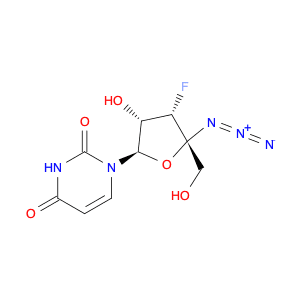
CAS 1365258-17-8
:4'-C-azido-3'-deoxy-3'-fluoro-Uridine
Description:
4'-C-azido-3'-deoxy-3'-fluoro-uridine is a modified nucleoside that features several notable characteristics. As a derivative of uridine, it contains an azido group at the 4' position and a fluorine atom at the 3' position, along with a deoxy modification at the 3' carbon. This compound is of interest in medicinal chemistry and virology due to its potential applications in antiviral therapies and as a building block for nucleic acid synthesis. The azido group can participate in click chemistry reactions, making it useful for bioconjugation and labeling studies. The presence of the fluorine atom may enhance the compound's stability and bioavailability compared to its unmodified counterparts. Additionally, the structural modifications can influence the compound's interaction with nucleic acid targets, potentially affecting its efficacy as an antiviral agent. Overall, 4'-C-azido-3'-deoxy-3'-fluoro-uridine represents a valuable tool in the development of nucleoside analogs for therapeutic applications.
Formula:C9H10FN5O5
Synonyms:- 4'-C-azido-3'-deoxy-3'-fluoro-Uridine
Sort by
Purity (%)
0
100
|
0
|
50
|
90
|
95
|
100
Found 2 products.
4'-C-Azido-3'-deoxy-3'-fluorouridine
CAS:4'-C-Azido-3'-deoxy-3'-fluorouridine (4-CADU) is a novel nucleoside that has been shown to have antiviral and anticancer activities. 4-CADU is synthesized as a monophosphate, which undergoes dephosphorylation by phosphatases to form the corresponding ribonucleotide. The phosphate group is then removed through hydrolysis by esterases or glucuronidases and the product of this reaction is an erythromycin intermediate that can be converted to 4-CADU in vitro. This drug has also been shown to inhibit the growth of bacteria such as Mycobacterium tuberculosis and Mycobacterium avium complex.
Formula:C9H10FN5O5Purity:Min. 95%Molecular weight:287.2 g/mol