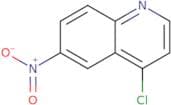
CAS 13675-94-0
:4-Chloro-6-nitroquinoline
Description:
4-Chloro-6-nitroquinoline is a heterocyclic organic compound characterized by a quinoline backbone, which consists of a fused benzene and pyridine ring. The presence of a chlorine atom at the 4-position and a nitro group at the 6-position contributes to its unique chemical properties. This compound typically appears as a yellow to orange crystalline solid and is known for its potential applications in medicinal chemistry, particularly in the development of antimicrobial and antitumor agents. Its molecular structure allows for various chemical reactions, including electrophilic substitutions and reductions, making it a versatile intermediate in organic synthesis. Additionally, 4-Chloro-6-nitroquinoline may exhibit biological activity, which has been the subject of research in pharmacology. As with many nitro-containing compounds, it is important to handle this substance with care due to potential toxicity and environmental concerns. Proper safety measures should be observed when working with this compound in laboratory settings.
Formula:C9H5ClN2O2
InChI:InChI=1/C9H5ClN2O2/c10-8-3-4-11-9-2-1-6(12(13)14)5-7(8)9/h1-5H
SMILES:c1cc2c(cc1N(=O)=O)c(ccn2)Cl
Synonyms:- Quinoline, 4-Chloro-6-Nitro-
Sort by
Purity (%)
0
100
|
0
|
50
|
90
|
95
|
100
Found 4 products.
Quinoline, 4-chloro-6-nitro-
CAS:Formula:C9H5ClN2O2Purity:98%Color and Shape:SolidMolecular weight:208.60124-Chloro-6-nitroquinoline
CAS:Formula:C9H5ClN2O2Purity:98%Color and Shape:SolidMolecular weight:208.64-Chloro-6-nitroquinoline
CAS:4-Chloro-6-nitroquinoline is a dopamine receptor antagonist that has been shown to have high affinity and selectivity for the 5-HT6 receptor. This agent inhibits the binding of serotonin to 5-HT6 receptors, which causes an increase in dopamine release in the brain. 4-Chloro-6-nitroquinoline has been used in a study of Parkinson's disease and depression in humans.Formula:C9H5ClN2O2Purity:Min. 95%Molecular weight:208.6 g/mol