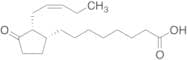
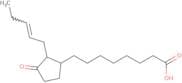
![8-{(1R,2R)-3-oxo-2-[(2Z)-pent-2-en-1-yl]cyclopentyl}octanoic acid](/_next/image/?url=https%3A%2Fstatic.cymitquimica.com%2Fcas-image%2Fthumb-webp%2F43629-8-1r-2r-3-oxo-2-2z-pent-2-en-1-yl-cyclopentyl-octanoic-acid.webp&w=3840&q=75)
CAS 136845-14-2
:8-{(1R,2R)-3-oxo-2-[(2Z)-pent-2-en-1-yl]cyclopentyl}octanoic acid
Description:
The chemical substance known as 8-{(1R,2R)-3-oxo-2-[(2Z)-pent-2-en-1-yl]cyclopentyl}octanoic acid, with the CAS number 136845-14-2, is a complex organic compound characterized by its unique structural features. It contains a cyclopentyl ring, which contributes to its cyclic nature, and a long octanoic acid chain that provides hydrophobic characteristics. The presence of a ketone functional group (3-oxo) and a double bond in the pentenyl side chain adds to its reactivity and potential biological activity. This compound is likely to exhibit amphiphilic properties due to the combination of hydrophilic (carboxylic acid) and hydrophobic (alkyl chains) segments, which can influence its solubility and interaction with biological membranes. Its stereochemistry, indicated by the (1R,2R) configuration, suggests specific spatial arrangements that may affect its biological activity and interactions with enzymes or receptors. Overall, this compound may have applications in pharmaceuticals or biochemistry, particularly in studies related to metabolic pathways or as a potential bioactive molecule.
Formula:C18H30O3
InChI:InChI=1/C18H30O3/c1-2-3-7-11-16-15(13-14-17(16)19)10-8-5-4-6-9-12-18(20)21/h3,7,15-16H,2,4-6,8-14H2,1H3,(H,20,21)/b7-3-/t15-,16-/m1/s1
SMILES:CC/C=C\C[C@@H]1[C@H](CCCCCCCC(=O)O)CCC1=O
Sort by
Purity (%)
0
100
|
0
|
50
|
90
|
95
|
100
Found 2 products.
(±)-OPC-8
CAS:Controlled ProductApplications (±)-OPC-8 can be used in biological study for reassessing the role of phospholipase D in the Arabidopsis wounding response. Plants respond to wounding by means of a multitude of reactions, with the purpose of stifling herbivore assault.
References Bargmann, B. O. R., et al.: Plant Cell Environ., 32, 837-850 (2009)Formula:C18H30O3Color and Shape:NeatMolecular weight:294.429OPC-8
CAS:OPC-8 is a potent inhibitor of protein kinases, which are enzymes that play a crucial role in the regulation of cell growth and division. This compound has been found in the urine of Chinese patients with cancer and has shown promising anticancer activity in vitro. OPC-8 is an analog of nintedanib, another kinase inhibitor that is currently used for the treatment of certain cancers. OPC-8 induces apoptosis, or programmed cell death, in cancer cells by inhibiting their ability to proliferate and survive. This compound has also shown efficacy against various types of tumors and may be a promising candidate for future cancer therapies. With its unique properties as a kinase inhibitor, OPC-8 represents a potential breakthrough in the fight against cancer.Formula:C18H30O3Purity:Min. 95%Molecular weight:294.4 g/mol