CAS 136941-85-0
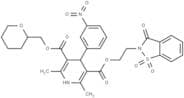
:2-(1,1-dioxido-3-oxo-1,2-benzisothiazol-2(3H)-yl)ethyl tetrahydro-2H-pyran-2-ylmethyl 2,6-dimethyl-4-(3-nitrophenyl)-1,4-dihydropyridine-3,5-dicarboxylate
Description:
The chemical substance with the name "2-(1,1-dioxido-3-oxo-1,2-benzisothiazol-2(3H)-yl)ethyl tetrahydro-2H-pyran-2-ylmethyl 2,6-dimethyl-4-(3-nitrophenyl)-1,4-dihydropyridine-3,5-dicarboxylate" and CAS number 136941-85-0 is a complex organic compound characterized by multiple functional groups and a diverse molecular structure. It features a benzisothiazole moiety, which contributes to its potential biological activity, and a dihydropyridine structure known for its role in various pharmacological applications. The presence of dicarboxylate groups suggests potential for reactivity and solubility in polar solvents. Additionally, the nitrophenyl substituent may impart specific electronic properties, influencing the compound's reactivity and interaction with biological targets. The tetrahydropyran ring adds to the compound's structural diversity, potentially affecting its conformational flexibility and stability. Overall, this compound may exhibit interesting pharmacological properties, making it a candidate for further research in medicinal chemistry and drug development. However, detailed studies would be necessary to elucidate its specific biological activities and mechanisms of action.
Formula:C30H31N3O10S
InChI:InChI=1/C30H31N3O10S/c1-18-25(29(35)42-15-13-32-28(34)23-11-3-4-12-24(23)44(32,39)40)27(20-8-7-9-21(16-20)33(37)38)26(19(2)31-18)30(36)43-17-22-10-5-6-14-41-22/h3-4,7-9,11-12,16,22,27,31H,5-6,10,13-15,17H2,1-2H3
SMILES:CC1=C(C(c2cccc(c2)N(=O)=O)C(=C(C)N1)C(=O)OCC1CCCCO1)C(=O)OCCN1C(=O)c2ccccc2S1(=O)=O
Sort by
Purity (%)
0
100
|
0
|
50
|
90
|
95
|
100
Found 2 products.
PCA50941
CAS:PCA50941 is a peptide that has been shown to be an activator of ion channels. It is used as a research tool in the study of cell biology and pharmacology. PCA50941 binds to the receptor and stimulates it, which leads to the opening of voltage-gated potassium channels. This causes the membrane potential to increase, leading to depolarization. PCA50941 also interacts with ligands and receptors, leading to changes in their activity. The binding of PCA50941 with its receptors can lead to inhibition or activation depending on the type of receptor.Formula:C30H31N3O10SPurity:Min. 95%Molecular weight:625.6 g/molPCA50941
CAS:PCA50941 is a 1,4-dihydropyridine derivative, treatment for cardiovascular disease.Formula:C30H31N3O10SPurity:98%Color and Shape:SolidMolecular weight:625.65