CAS 137191-59-4
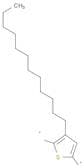
:Poly(3-dodecyl-2,5-thiophenediyl)
Description:
Poly(3-dodecyl-2,5-thiophenediyl) is a conjugated polymer characterized by its repeating units of 3-dodecyl-2,5-thiophenediyl, which contributes to its semiconducting properties. This polymer exhibits a high degree of planarity due to the thiophene rings, facilitating effective π-π stacking and charge transport. Its dodecyl side chains enhance solubility in organic solvents, making it suitable for various processing techniques, including solution casting and inkjet printing. The presence of the long alkyl chains also improves the polymer's film-forming ability and mechanical properties. Poly(3-dodecyl-2,5-thiophenediyl) is often utilized in organic electronics, particularly in organic field-effect transistors (OFETs) and organic photovoltaic cells, due to its favorable electronic properties and stability. Additionally, its optical properties allow for absorption in the visible spectrum, making it a candidate for light-harvesting applications. Overall, this polymer's unique structural features and properties make it a significant material in the field of organic electronics and materials science.
Formula:(C16H26S)n
Synonyms:- Poly(3,4′-didodecyl[2,2′-bithiophene]-5,5′-diyl)
- Poly(3-dodecyl-2,5-thiophenediyl)
- 2,5-Dibromo-3-dodecylthiophene homopolymer, regioregular SRU
- Poly(3-dodecylthiophene), regioregular SRU
- 2-Bromo-5-iodo-3-dodecylthiophene homopolymer, regioregular SRU
Sort by
Purity (%)
0
100
|
0
|
50
|
90
|
95
|
100
Found 2 products.
Poly(3-dodecyl-2,5-thiophenediyl)
CAS:Formula:C16H26SPurity:98%Color and Shape:SolidMolecular weight:250.4426Poly(3-dodecylthiophene-2,5-diyl)
CAS:<p>Poly(3-dodecylthiophene-2,5-diyl) is a semiconducting polymer that is used in the fabrication of organic light emitting diodes (OLEDs). Poly(3-dodecylthiophene-2,5-diyl) has been shown to have a morphology that consists of small spherical domains. The density of these domains can be controlled by changing the solvent conditions. This polymer also has an optical absorption spectrum that peaks at 450 nm. When Poly(3-dodecylthiophene-2,5-diyl) is in contact with other molecules, it will form supramolecular complexes through noncovalent interactions and temperature dependent evaporation. These complexes are responsible for interactions between the polymer and other molecules. The x-ray absorption spectra of Poly(3-dodecylthiophene-2,5-diyl) show a significant increase in intensity when exposed</p>Purity:Min. 95%