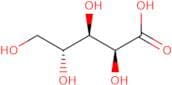
CAS 13752-83-5
:Arabinonic acid
Description:
Arabinonic acid is a sugar acid derived from arabinose, a pentose monosaccharide. It is characterized by its molecular formula, which typically includes a carboxylic acid functional group, contributing to its acidic properties. Arabinonic acid exists in various stereoisomeric forms, with the most common being the D-form. This compound is a white crystalline solid that is soluble in water, reflecting its polar nature due to the presence of hydroxyl and carboxyl groups. Arabinonic acid is often studied in the context of carbohydrate chemistry and biochemistry, as it can participate in various biochemical pathways and reactions. Its derivatives may have applications in pharmaceuticals and food chemistry, particularly in the development of sweeteners or as intermediates in organic synthesis. Additionally, arabinonic acid can be involved in the metabolism of certain microorganisms, making it of interest in microbiological studies. Overall, its unique structural features and reactivity make arabinonic acid a compound of interest in both academic and industrial research.
Formula:C5H10O6
InChI:InChI=1/C5H10O6/c6-1-2(7)3(8)4(9)5(10)11/h2-4,6-9H,1H2,(H,10,11)/t2-,3-,4+/s2
InChI key:InChIKey=QXKAIJAYHKCRRA-YREPKBLCNA-N
SMILES:[C@H]([C@@H](C(O)=O)O)([C@@H](CO)O)O
Synonyms:- Arabinoic acid
- Arabinonic acid
- Arabonic acid
- D-arabinonic acid
Sort by
Purity (%)
0
100
|
0
|
50
|
90
|
95
|
100
Found 1 products.
D-Arabonic acid
CAS:D-Arabonic acid is an acidic compound that is a sodium salt of D-arabitol. It is used as a kinetic, reactive model system for the study of the mechanism of action and inhibition of enzymes such as polymerase chain reaction (PCR) and DNA-dependent RNA polymerase (RdRP). D-Arabonic acid has been shown to be a potent inhibitor of these enzymes, although it does not inhibit other enzyme classes. The target enzyme binds to the substrate by electrostatic interactions with the negative oxygen atoms on the nitrogen atoms in its basic structure. The reaction mechanism may involve oxidation catalysts such as iron or copper ions. Kinetic data can be obtained using laser ablation.Formula:C5H10O6Purity:Min. 95%Molecular weight:166.13 g/mol