CAS 137832-56-5
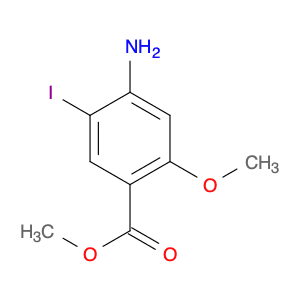
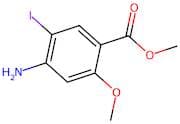
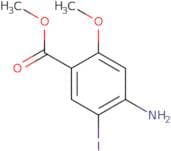
:methyl 4-amino-5-iodo-2-methoxy-benzoate
Description:
Methyl 4-amino-5-iodo-2-methoxy-benzoate, with the CAS number 137832-56-5, is an organic compound characterized by its aromatic structure, which includes a methoxy group and an amino group attached to a benzoate moiety. This compound features an iodine atom, which contributes to its unique reactivity and potential applications in medicinal chemistry. The presence of the methoxy group enhances its solubility in organic solvents and may influence its biological activity. Methyl 4-amino-5-iodo-2-methoxy-benzoate is typically a solid at room temperature and may exhibit moderate stability under standard conditions. Its functional groups suggest potential for hydrogen bonding and interactions with biological targets, making it of interest in pharmaceutical research. Additionally, the iodine substituent may facilitate further chemical modifications or serve as a labeling agent in imaging studies. Overall, this compound's structural features position it as a valuable candidate for further investigation in various chemical and biological applications.
Formula:C9H10INO3
InChI:InChI=1/C9H10INO3/c1-13-8-4-7(11)6(10)3-5(8)9(12)14-2/h3-4H,11H2,1-2H3
SMILES:COc1cc(c(cc1C(=O)OC)I)N
Sort by
Purity (%)
0
100
|
0
|
50
|
90
|
95
|
100
Found 5 products.
Methyl 4-amino-5-iodo-2-methoxybenzoate
CAS:Formula:C9H10INO3Purity:95%Color and Shape:SolidMolecular weight:307.087Benzoic acid, 4-amino-5-iodo-2-methoxy-, methyl ester
CAS:Formula:C9H10INO3Purity:98%Color and Shape:SolidMolecular weight:307.0851Methyl 4-amino-5-iodo-2-methoxybenzoate
CAS:Methyl 4-amino-5-iodo-2-methoxybenzoatePurity:95%Molecular weight:307.087g/molMethyl 4-amino-5-iodo-2-methoxybenzoate
CAS:Methyl 4-amino-5-iodo-2-methoxybenzoate is a chemical compound that is used to synthesize other compounds. It is used in the synthesis of alkaloids, such as clausine and glycozoline. The intramolecular arylation of boronic acids with methyl 4-amino-5-iodo-2-methoxybenzoate provides an efficient methodology for the synthesis of cross-coupled products. This reaction can be carried out using copper as a catalyst, which has been shown to reduce the need for expensive reagents.Formula:C9H10INO3Purity:Min. 95%Molecular weight:307.09 g/mol