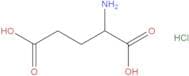
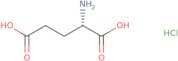
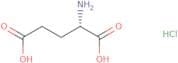
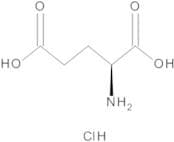
CAS 138-15-8
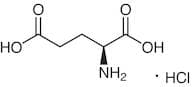
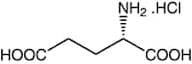
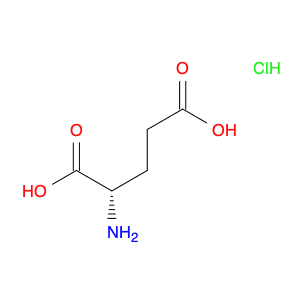
:L(+)-Glutamic acid hydrochloride
Description:
L(+)-Glutamic acid hydrochloride, with the CAS number 138-15-8, is the hydrochloride salt of L-glutamic acid, an amino acid that plays a crucial role in cellular metabolism and neurotransmission. This compound is typically a white crystalline powder that is soluble in water, making it useful in various applications, including food flavoring and as a dietary supplement. L-glutamic acid is classified as a non-essential amino acid, meaning that it can be synthesized by the body. It is known for its role as an excitatory neurotransmitter in the central nervous system, contributing to cognitive functions such as learning and memory. In addition to its biological significance, L(+)-glutamic acid hydrochloride is often utilized in the pharmaceutical industry and in research settings. Its safety profile is generally favorable, although excessive intake may lead to adverse effects in sensitive individuals. Overall, this compound is valued for its functional properties in both biological and industrial contexts.
Formula:C5H10ClNO4
InChI:InChI=1/C5H9NO4.ClH/c6-3(5(9)10)1-2-4(7)8;/h3H,1-2,6H2,(H,7,8)(H,9,10);1H/t3-;/m0./s1
InChI key:InChIKey=RPAJSBKBKSSMLJ-DFWYDOINSA-N
SMILES:[C@H](CCC(O)=O)(C(O)=O)N.Cl
Synonyms:- 2-Aminopentanedioic acid hydrochloride
- <span class="text-smallcaps">L</span>(+)-Glutamic acid hydrochloride
- <span class="text-smallcaps">L</span>-Glutamic acid monohydrochloride
- <span class="text-smallcaps">L</span>-Glutamic acid, hydrochloride (1:1)
- Acidalin
- Acidogen
- Acidoride
- Acidothyn
- Acidulen
- Acidulin
- Aciglumin
- Aclor
- Acridogen
- Acridoride
- Antalka
- Gastuloric
- Glusatin
- Glutamic Acid Hydrochloride (1:1)
- Glutamic acid hydrochloride
- Glutamic acid monohydrochloride
- Glutamic acid, hydrochloride, <span class="text-smallcaps">L</span>-
- Glutamidin
- Glutan HCl
- Glutan Hydrochloric
- Glutan hydrochloride
- Glutasin
- Hydrionic
- Hypochylin
- L-Glutamic Acid HCL
- Muriamic
- NSC 9239
- Pepsdol
- Pepsidol
- Glutamic acid, hydrochloride, L-
- L-Glutamic acid, hydrochloride (1:1)
- L-(+)-Glutamic acid hydrochloride
- L-Glutamic acid, hydrochloride
- L-Glutamic acid hydrochloride
- L-(+)-Glutamic Acid Hydrochloride
- GLUTAMIC ACID HCL
- L-GLU HCL
- L-2-AMINOGLUTARIC ACID HYDROCHLORIDE
- 2-aminopentanedioicacidhydrochloride
- H-GLU-OH HCL
- [S]-2-AMINOPENTANEDIOIC ACID HYDROCHLORIDE
- (S)-2-AMINOGLUTARIC ACID HYDROCHLORIDE
- See more synonyms
Sort by
Purity (%)
0
100
|
0
|
50
|
90
|
95
|
100
Found 11 products.
L-Glutamic Acid Hydrochloride
CAS:Formula:C5H9NO4·HClPurity:>98.0%(T)(HPLC)Color and Shape:White to Almost white powder to crystalMolecular weight:183.59L-Glutamic acid hydrochloride, 99%
CAS:L-Glutamic acid hydrochloride is used as a digestive aid. It is used in cell culture as a component of MEM non-essential amino acids solution. It has been used as a nitrogen source in the culture of Aspergillus fumigatus NRRL 2436 for fumagillin production. This Thermo Scientific Chemicals brand proFormula:C5H10ClNO4Purity:99%Color and Shape:White, Crystals or powder or crystalline powderMolecular weight:183.59L-Glutamic Acid Hydrochloride
CAS:Glutamic acid and its saltsFormula:C5H9NO4·HCIColor and Shape:PowderMolecular weight:286.96545Glutamic acid, hydrochloride
CAS:Formula:C5H10ClNO4Purity:98%Color and Shape:SolidMolecular weight:183.5902L-Glutamic acid hydrochloride
CAS:Formula:C5H9NO4HClPurity:(Titration) ≥ 99.0%Color and Shape:White to almost white powderMolecular weight:183.59L-Glutamic acid hydrochloride
CAS:L-Glutamic acid hydrochloride is a high quality reagent that is used as an intermediate in the production of fine chemicals. It is also used as a useful scaffold for the synthesis of valuable compounds and as a useful building block for research chemicals. L-Glutamic acid hydrochloride can be used in reactions to produce versatile building blocks, reaction components, and other speciality chemicals.Formula:C5H10ClNO4Purity:Min. 98 Area-%Molecular weight:183.59 g/molL-(+)-Glutamic acid HCl
CAS:L-(+)-Glutamic acid HCl is a monosodium salt that belongs to the group of water-soluble organic acids. It has been used as a food additive and in wastewater treatment, as well as for the production of polymers and pharmaceuticals. Glutamate can be converted to glutamic acid by hydrolysis with sodium hydroxide or other strong bases. Glutamic acid is an important biochemical precursor in the synthesis of proteins, peptides, and nucleic acids. It also functions as a neurotransmitter in the central nervous system. L-(+)-glutamic acid HCl has been shown to induce apoptosis in human HL-60 cells by increasing reactive oxygen species (ROS) levels and activating caspase-3 activity in these cells. The crystalline cellulose used in this study was obtained from cellulose powder (Avicel PH101).Formula:C5H9NO4·HClPurity:Min. 95%Color and Shape:White PowderMolecular weight:183.59 g/molL-Glutamic Acid Hydrochloride
CAS:Controlled ProductFormula:C5H9NO4·ClHColor and Shape:NeatMolecular weight:183.59