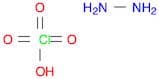
CAS 13812-39-0
:Hydrazine, perchlorate (1:2)
Description:
Hydrazine perchlorate (1:2) is an inorganic compound characterized by its composition of hydrazine and perchlorate ions in a 1:2 ratio. It is typically encountered as a white crystalline solid that is highly soluble in water. This compound is known for its energetic properties, making it of interest in the field of propellants and explosives. Hydrazine perchlorate is sensitive to heat and shock, which necessitates careful handling and storage to prevent unintended detonation. The presence of hydrazine contributes to its reducing properties, while the perchlorate ion acts as a strong oxidizer, facilitating combustion reactions. Due to its potential hazards, including toxicity and environmental concerns, it is regulated in many jurisdictions. Safety measures, including the use of personal protective equipment and proper ventilation, are essential when working with this substance. Overall, hydrazine perchlorate serves as a significant compound in various applications, particularly in aerospace and military industries, where its energetic characteristics are utilized.
Formula:ClHO4H4N2
InChI:InChI=1S/ClHO4.H4N2/c2-1(3,4)5;1-2/h(H,2,3,4,5);1-2H2
InChI key:InChIKey=HFPDJZULJLQGDN-UHFFFAOYSA-N
SMILES:Cl(=O)(=O)(=O)O.NN
Synonyms:- Perchloric acid, compd. with hydrazine (2:1)
- Hydrazine, diperchlorate
- Hydrazinium diperchlorate
- Hydrazine, perchlorate (1:2)
Sort by
Purity (%)
0
100
|
0
|
50
|
90
|
95
|
100
Found 2 products.
Hydrazinium diperchlorate
CAS:Controlled ProductHydrazinium diperchlorate is a reaction product of hydrogen fluoride and diammonium hydroxide that forms on the surface of a gel matrix. The rate of reaction increases with increasing concentrations of diammonium hydroxide, hydrogen chloride, and chloride ions. This product also contains impurities such as ammonium nitrate, which can be eliminated by activation energy. Hydrazinium diperchlorate is used in oxidizer reactions to produce heat and light energy from the combustion of fuel. A kinetic study has been performed to determine the rate at which this chemical reacts with oxygen and water.
Purity:Min. 95%