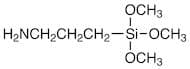
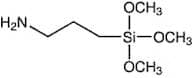
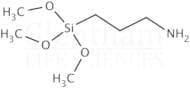
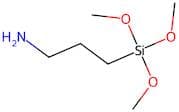
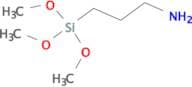
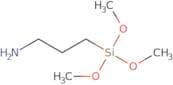
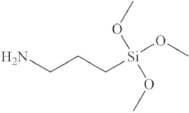
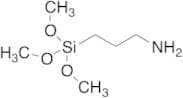
CAS 13822-56-5
:Aminopropyltrimethoxysilane
- (3-Aminopropyl)trimethoxysilane
- (γ-Aminopropyl)trimethoxysilane
- 1-(Trimethoxysilyl)Propan-1-Amine
- 1-Propanamine, 3-(trimethoxysilyl)-
- 3-(Trimethoxysilanyl)propylamine
- 3-(Trimethoxysilyl)-1-propanamine
- 3-(Trimethoxysilyl)-1-propyl amine
- 3-(Trimethoxysilyl)Propan-1-Amine
- 3-(Trimethoxysilyl)propylamin
- 3-(Trimethoxysilyl)propylamine
- 3-(Trimetoxisilil)Propilamina
- 3-AMinopropyltriMethoxy silane
- A 0800
- A 1001
- A 110
- A 110 (coupling agent)
- A 1108
- A 1110
- A 301
- AP-Si 3M
- Aminopropyltrimethoxysilane
- Ammo
- Aptms
- Ay 43-059P
- Cg 551
- Db 551
- Dynasylan AMMO
- Geniosil GF 96
- Gx 540
- Jh 56
- Jh-A 111
- KH 170 (coupling agent)
- Kbm 903
- Kbm 903P
- Kbm 903Tmi
- Kh 1101
- Kh 170
- Kh 540
- Kh 551
- Kh 555
- Kh540
- Kmb 903
- Ls 1420
- Lt 540
- NUC Silane A 1110
- Nsc 83845
- Pc 1110
- Propan-1-Amine, 3-(Trimethoxysilyl)-
- Propylamine, 3-(trimethoxysilyl)-
- S 360
- SG-Si 1110
- Sc 3900
- Sca 1103
- Sca-A 10E
- Sia 0611.0
- Sila-Ace MS 3301
- Sila-Ace S 360
- Silane Coupling Agent A-1110
- Silane Coupling Agent KH-540
- Silane SC 3900
- Silquest A 1108
- Silquest A 1110
- Toray Silicone Z 6610
- Trimethoxy(3-aminopropyl)silane
- Tsl 8330
- Tsl 8331E
- Usi 1302
- Wd 56
- Z 6610
- γ-Aminopropyltrimethoxysilane
- 3-(trimethoxysilyl)-1-propanamin
- 3-Aminopropyltrimethoxysilane, 97+%
- 3-AMINOPROPYLTRIMETHOXYSILANE
- N-(Trimethoxysilylpropyl)amine
- GAMMA-AMINOPROPYLTRIMETHOXYSILANE
- 3-AMINOPROPYLTRIMETHOXYSILANE 98%
- 3-Aminopropyltrimethoxysilane(3-Trimethoxysilylpropylamine)
- KBE 903
- Trimethoxyaminopropylsilane
- Union Carbide A-1110
- CA0880
- γ-Trimethoxysilyl propylamine
- See more synonyms
3-Aminopropyltrimethoxysilane
CAS:Formula:C6H17NO3SiPurity:>96.0%(GC)(T)Color and Shape:Colorless to Almost colorless clear liquidMolecular weight:179.29(3-Aminopropyl)trimethoxysilane, 97%
CAS:(3-Aminopropyl)trimethoxysilane is used as a silane coupling agent on silver nanoparticles. It is also used in silanization processes. It is also used to prepare surface modified titanate nanotubes (TiNT). This Thermo Scientific Chemicals brand product was originally part of the Alfa Aesar producFormula:C6H17NO3SiPurity:97%Color and Shape:Clear colorless, LiquidMolecular weight:179.293-Aminopropyltrimethoxysilane
CAS:Formula:C6H17NO3SiPurity:≥ 96.0%Color and Shape:Colourless liquidMolecular weight:179.29(3-Aminopropyl)trimethoxysilane
CAS:(3-Aminopropyl)trimethoxysilanePurity:98%Molecular weight:179.29g/mol3-Aminopropyltrimethoxysilane
CAS:S00825 - 3-Aminopropyltrimethoxysilane
Formula:C6H17NO3SiPurity:97%Color and Shape:Clear LiquidMolecular weight:179.2913-Aminopropyltrimethoxysilane
CAS:3-Aminopropyltrimethoxysilane is a chemical that belongs to the group of aminopropyltriethoxysilanes. It is a reactive substance and is commonly used as an additive in adhesives and sealants. 3-Aminopropyltrimethoxysilane has been shown to be an efficient coupling agent for the formation of hydroxyl groups on nanoparticles, which are then used as drug carriers. The optimum concentration of 3-aminopropyltrimethoxysilane lies between 0.01 and 0.1 M, with a pH range of 6 and 8. This chemical can react with hydrochloric acid, resulting in the production of hydrogen gas; with cervical cancer cells in culture, leading to cell death; or with skin cells, causing damage to their transport properties.Formula:C6H17NO3SiPurity:Min. 95%Color and Shape:Clear LiquidMolecular weight:179.29 g/mol3-AMINOPROPYLTRIMETHOXYSILANE
CAS:Monoamine Functional Trialkoxy Silane
Silane coupling agents have the ability to form a durable bond between organic and inorganic materials to generate desired heterogeneous environments or to incorporate the bulk properties of different phases into a uniform composite structure. The general formula has two classes of functionality. The hydrolyzable group forms stable condensation products with siliceous surfaces and other oxides such as those of aluminum, zirconium, tin, titanium, and nickel. The organofunctional group alters the wetting or adhesion characteristics of the substrate, utilizes the substrate to catalyze chemical transformations at the heterogeneous interface, orders the interfacial region, or modifies its partition characteristics, and significantly effects the covalent bond between organic and inorganic materials.
3-Aminopropyltrimethoxysilane, Trimethoxysilylpropylamine, ?-Aminopropyltrimethoxysilane, APTES, AMEO, GAPS, A-1100
Higher purity material available as SIA0611.1Vapor pressure, 67 °: 5 mmSuperior reactivity in vapor phase and non-aqueous surface treatmentsPrimary amine coupling agent for UV cure and epoxy systemsHydrolysis rate vs SIA0610.0 : 6:1Used to immobilize Cu and Zn Schiff base precatalysts for formation of cyclic carbonatesUsed in microparticle surface modificationFormula:C6H17NO3SiPurity:97%Color and Shape:Straw LiquidMolecular weight:179.293-AMINOPROPYLTRIMETHOXYSILANE, 99%
CAS:Monoamine Functional Trialkoxy Silane
Silane coupling agents have the ability to form a durable bond between organic and inorganic materials to generate desired heterogeneous environments or to incorporate the bulk properties of different phases into a uniform composite structure. The general formula has two classes of functionality. The hydrolyzable group forms stable condensation products with siliceous surfaces and other oxides such as those of aluminum, zirconium, tin, titanium, and nickel. The organofunctional group alters the wetting or adhesion characteristics of the substrate, utilizes the substrate to catalyze chemical transformations at the heterogeneous interface, orders the interfacial region, or modifies its partition characteristics, and significantly effects the covalent bond between organic and inorganic materials.
3-Aminopropyltrimethoxysilane, Trimethoxysilylpropylamine, APTES, AMEO, GAPS, A-1100, ?-Aminopropyltrimethoxysilane
Vapor pressure, 67 °: 5 mmSuperior reactivity in vapor phase and non-aqueous surface treatmentsSuperior reactivity in vapor phase and non-aqueous surface treatmentsHydrolysis rate vs SIA0610.0 : 6:1Used to immobilize Cu and Zn Schiff base precatalysts for formation of cyclic carbonatesUsed in microparticle surface modification Standard grade available as SIA0611.0Formula:C6H17NO3SiPurity:99%Color and Shape:Straw LiquidMolecular weight:179.29(3-Aminopropyl)trimethoxysilane
CAS:Controlled ProductApplications (3-Aminopropyl)trimethoxysilane is used in the synthesis of aspirin imprinted polymer on silica gel surface and appreciation on drug sustained release. Fluorine-doped; lectin functionalized ZnO nanoarrays as 3D nano-biointerface for bacterial detection.
References Lu, P., et al.: Gaofenzi Cailiao Kexue Yu Gongcheng, 33, 130 (2017); Zheng, L., Talanta, 167, 600 (2017)Formula:C6H17NO3SiColor and Shape:NeatMolecular weight:179.29