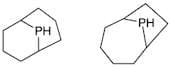
![9-Phosphabicyclo[3.3.1]nonane](/_next/image/?url=https%3A%2Fstatic.cymitquimica.com%2Fcas-image%2Fthumb-webp%2F298301-9-phosphabicyclo-3-3-1-nonane.webp&w=3840&q=75)
CAS 13887-02-0
:9-Phosphabicyclo[3.3.1]nonane
Description:
9-Phosphabicyclo[3.3.1]nonane is a bicyclic compound featuring a phosphorus atom integrated into its structure, which is characteristic of phosphabicyclic compounds. This substance is notable for its unique bicyclic framework, consisting of two fused cyclopropane rings and a phosphorus atom located at the bridgehead position. The presence of phosphorus introduces distinct chemical properties, such as potential reactivity in nucleophilic and electrophilic reactions. It is often studied for its applications in organic synthesis and as a ligand in coordination chemistry. The compound may exhibit interesting stereochemical properties due to its rigid structure, influencing its reactivity and interaction with other chemical species. Additionally, its physical properties, such as solubility and boiling point, can vary based on the specific conditions and the presence of substituents. Overall, 9-Phosphabicyclo[3.3.1]nonane represents a fascinating area of study within organophosphorus chemistry, with implications for both theoretical research and practical applications.
Formula:C8H15P
InChI:InChI=1S/C8H15P/c1-3-7-5-2-6-8(4-1)9-7/h7-9H,1-6H2
InChI key:InChIKey=QJCMAJXWIAFFED-UHFFFAOYSA-N
SMILES:C12PC(CCC1)CCC2
Synonyms:- 9-Phosphabicyclo(3.3.1)nonane
- Phoban
- 9-Phosphabicyclo[3.3.1]nonane
Sort by
Purity (%)
0
100
|
0
|
50
|
90
|
95
|
100
Found 2 products.
9-Phosphabicyclononanes in toluene, mixture of isomers, CYTOP® 282T
CAS:Formula:C8H15PColor and Shape:Colorless to pale yellow liq.Molecular weight:142.179-Phosphabicyclononanes (mixture of isomers) in toluene
CAS:9-Phosphabicyclo[3.3.1]nonane (9-PBN) is the simplest member of a class of phosphorus compounds that can be used as an efficient and economical reagent for cross-coupling reactions in organic synthesis. 9-PBN is a stable, white solid that is soluble in hydrocarbon solvents and reacts with nucleophiles such as amines, alcohols, and thiols to form phosphine oxides (PR 3 ). 9-PBN undergoes rapid isomerization between the cis and trans configurations at room temperature. When heated, it converts to the cis configuration at a rate that depends on the activation energy of the reaction. It has been proposed that this conversion may be catalyzed by acid or base catalysis because of its acidic nature or polydentate ligand properties. 9-PBN has been shown to react with primary alcohols to form amides via nucleophilic attack onFormula:C8H15PPurity:Min. 95%Color and Shape:PowderMolecular weight:142.18 g/mol