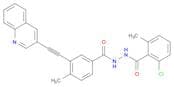
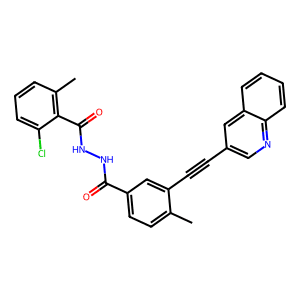
CAS 1388803-90-4
:Vodobatinib
Description:
Vodobatinib, with the CAS number 1388803-90-4, is a small molecule inhibitor primarily targeting the tyrosine kinase activity of certain proteins involved in cellular signaling pathways. It is particularly noted for its potential application in the treatment of various cancers, including those driven by mutations in the BCR-ABL gene, which is commonly associated with chronic myeloid leukemia (CML). The compound exhibits selectivity for specific kinases, which helps to minimize off-target effects and enhance therapeutic efficacy. Vodobatinib's mechanism of action involves the inhibition of ATP binding to the kinase domain, thereby disrupting downstream signaling that promotes tumor growth and survival. In terms of its physical and chemical properties, Vodobatinib is characterized by its molecular structure, which includes specific functional groups that contribute to its biological activity and solubility. Ongoing research and clinical trials continue to evaluate its safety, efficacy, and potential side effects in various patient populations.
Formula:C27H20ClN3O2
Synonyms:- Benzoic acid, 2-chloro-6-methyl-, 2-[4-methyl-3-[2-(3-quinolinyl)ethynyl]benzoyl]hydrazide
- Vodobatinib
- 2-Chloro-6-methyl-N'-(4-methyl-3-(quinolin-3-ylethynyl)benzoyl)benzohydrazide
- N'-(2-chloro-6-methylbenzoyl)-4-methyl-3-[2-(3-quinolyl)ethynyl]-benzohydrazide
Sort by
Purity (%)
0
100
|
0
|
50
|
90
|
95
|
100
Found 4 products.
Vodobatinib
CAS:Vodobatinib (K-0706) is a novel 3rd generation (3G) TKI effective against wild-type and mutated BCR-ABL1 with limited off-target activity.Formula:C27H20ClN3O2Purity:99.06% - 99.55%Color and Shape:SolidMolecular weight:453.92Ref: TM-T8882
1mg34.00€5mg74.00€10mg110.00€25mg200.00€50mg323.00€100mg500.00€500mg1,209.00€1mL*10mM (DMSO)82.00€Vodobatinib
CAS:Vodobatinib is a small molecule that inhibits the phosphorylation of tyrosine kinases and blocks the downstream cellular signaling pathways. It has been used in research to study protein interactions, activator, and ligand. Vodobatinib is also used as a reagent for antibody production. The compound has high purity and is suitable for use in life science studies.Formula:C27H20ClN3O2Purity:Min. 95%Molecular weight:453.9 g/mol