CAS 138968-85-1
:benastatin A
Description:
Benastatin A is a natural product classified as a polyketide, primarily known for its bioactive properties. It is derived from certain strains of the bacterium *Streptomyces*, which are known for producing a variety of secondary metabolites with potential pharmaceutical applications. The compound exhibits notable antitumor activity, making it of interest in cancer research. Structurally, benastatin A features a complex arrangement of carbon, hydrogen, and oxygen atoms, contributing to its biological activity. Its mechanism of action is thought to involve interference with cellular processes, although specific pathways may vary. Additionally, benastatin A has been studied for its potential effects on various biological systems, including its role in inhibiting specific enzymes or pathways involved in tumor growth. As with many natural products, the synthesis and extraction of benastatin A can be challenging, prompting ongoing research into its properties and potential therapeutic uses. Overall, benastatin A represents a significant compound in the field of medicinal chemistry and natural product research.
Formula:C30H28O7
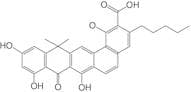
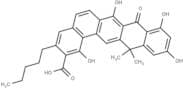
InChI:InChI=1/C30H28O7/c1-4-5-6-7-14-10-15-8-9-17-18(22(15)27(34)23(14)29(36)37)13-20-25(26(17)33)28(35)24-19(30(20,2)3)11-16(31)12-21(24)32/h8-13,31-34H,4-7H2,1-3H3,(H,36,37)
SMILES:CCCCCc1cc2ccc3c(cc4c(c3O)C(=O)c3c(cc(cc3O)O)C4(C)C)c2c(c1C(=O)O)O
Synonyms:- Benzo(a)naphthacene-2-carboxylic acid, 8,13-dihydro-13,13-dimethyl-8-oxo-3-pentyl-1,7,9,11-tetrahydroxy-
- 1,7,9,11-Tetrahydroxy-13,13-Dimethyl-8-Oxo-3-Pentyl-8,13-Dihydrobenzo[A]Tetracene-2-Carboxylic Acid
- Benastatin A
Sort by
Purity (%)
0
100
|
0
|
50
|
90
|
95
|
100
Found 3 products.
Benastatin A
CAS:Benastatin A, a polyketide from Streptomyces, inhibits GST (Ki=5 μM), fights MRSA (MIC=3.12 μg/ml), induces apoptosis and G1/G0 arrest in colon cancer cells.Formula:C30H28O7Color and Shape:SolidMolecular weight:500.54Benastatin A
CAS:Benastatin A is an antifungal compound, which is derived from marine-derived Streptomyces species. This bacterial genus, known for its prolific production of bioactive secondary metabolites, serves as a rich source for drug discovery and biosynthesis of unique compounds like Benastatin A. The mode of action of Benastatin A involves the disruption of fungal cell membranes, leading to leakage of vital cellular components and subsequent cell death. This interaction is crucial for understanding its efficacy and specificity against fungal pathogens.
Formula:C30H28O7Purity:Min. 95%Molecular weight:500.50 g/mol