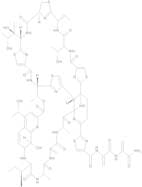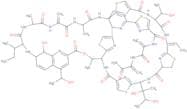
CAS 1393-48-2
:Thiostrepton
Description:
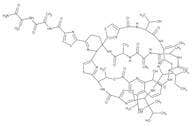
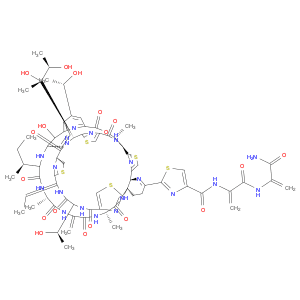
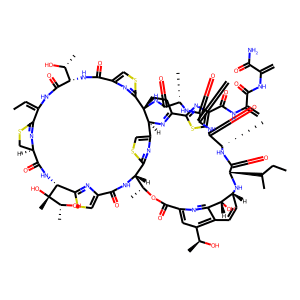
Thiostrepton is a naturally occurring thiopeptide antibiotic, primarily produced by the bacterium *Streptomyces azureus*. It is characterized by its complex structure, which includes a unique bicyclic core and multiple sulfur-containing moieties, contributing to its biological activity. Thiostrepton exhibits potent antimicrobial properties, particularly against Gram-positive bacteria, and has been studied for its potential applications in treating various infections. The compound functions by inhibiting protein synthesis, specifically targeting the ribosomal RNA, which disrupts the translation process in bacterial cells. In addition to its antibacterial effects, thiostrepton has shown promise in cancer research due to its ability to interfere with cellular signaling pathways. It is typically administered in a laboratory setting, and its use is primarily restricted to research purposes. Safety precautions are necessary when handling thiostrepton, as with many antibiotics, to prevent the development of resistance and ensure effective therapeutic outcomes. Overall, thiostrepton represents a significant compound in the field of microbiology and medicinal chemistry.
Formula:C72H85N19O18S5
InChI:InChI=1S/C72H85N19O18S5/c1-14-26(3)47-63(105)78-30(7)57(99)75-28(5)56(98)76-31(8)58(100)91-72-19-18-40(66-85-43(22-111-66)59(101)77-29(6)55(97)74-27(4)54(73)96)81-52(72)42-21-112-67(83-42)49(34(11)109-69(107)41-20-37(32(9)92)36-16-17-39(79-47)51(95)50(36)80-41)89-60(102)44-24-113-68(86-44)53(71(13,108)35(12)94)90-62(104)45-23-110-65(84-45)38(15-2)82-64(106)48(33(10)93)88-61(103)46-25-114-70(72)87-46/h15-17,20-22,24-26,30-35,39,45,47-49,51-53,79,92-95,108H,4-6,14,18-19,23H2,1-3,7-13H3,(H2,73,96)(H,74,97)(H,75,99)(H,76,98)(H,77,101)(H,78,105)(H,82,106)(H,88,103)(H,89,102)(H,90,104)(H,91,100)/b38-15-/t26-,30-,31-,32-,33+,34+,35+,39+,45+,47-,48-,49-,51-,52+,53+,71+,72+/m0/s1
InChI key:InChIKey=NSFFHOGKXHRQEW-AIHSUZKVSA-N
SMILES:O=C1N[C@]23[C@@](C=4N=C(SC4)[C@@](NC(=O)C=5N=C(SC5)[C@]([C@]([C@@H](C)O)(C)O)(NC(=O)[C@@]6(N=C(\C(=C\C)\NC(=O)[C@]([C@@H](C)O)(NC(=O)C=7N=C2SC7)[H])SC6)[H])[H])([C@@H](C)OC(=O)C=8N=C9C(=C([C@H](C)O)C8)C=C[C@]([C@@H]9O)(N[C@@]([C@H](CC)C)(C(=O)N[C@@H](C)C(=O)NC(=C)C(=O)N[C@H]1C)[H])[H])[H])(N=C(CC3)C%10=NC(C(NC(C(NC(C(N)=O)=C)=O)=C)=O)=CS%10)[H]
Synonyms:- Alaninamide, <span class="text-smallcaps">L</smallcap>-threonyl-(4S)-2-[(1Z)-1-amino-1-propenyl]-4,5-dihydro-4-thiazolecarbonyl-2-[(1S,2S,3R)-1-amino-2,3-dihydroxy-2-methylbutyl]-4-thiazolecarbonyl-2-[(5R,6S)-6-[2-[(1S,2R)-1-amino-2-hydroxypropyl]-4-thiazolyl]-5-[[N-[(7R,8S)-2-carboxy-7,8-dihydro-8-hydroxy-4-[(1S)-1-hydroxyethyl]-7-quinolinyl]-<smallcap>L</smallcap>-isoleucyl-<smallcap>L</smallcap>-alanyl-2,3-didehydroalanyl-<smallcap>L</span>-alanyl]amino]-5-(4-carboxy-2-thiazolyl)-3,4,5,6-tetrahydro-2-pyridinyl]-4-thiazolecarbonyl-2,3-didehydroalanyl-2,3-didehydro-, (1′→4)-lactone, (4→1)-lactam
- Alaninamide, N-[(7R,8S)-2-carboxy-7,8-dihydro-8-hydroxy-4-[(1S)-1-hydroxyethyl]-7-quinolinyl]-<span class="text-smallcaps">L</smallcap>-isoleucyl-<smallcap>L</smallcap>-alanyl-2,3-didehydroalanyl-<smallcap>L</span>-alanyl-2-[(4aR,11S,14Z,18S,21S,28S,32aS)-4a-amino-21-[(1S,2R)-1,2-dihydroxy-1-methylpropyl]-14-ethylidene-3,4,4a,9,10,11,12,13,14,18,19,20,21,27,28,32a-hexadecahydro-11,28-bis[(1R)-1-hydroxyethyl]-9,12,19,26-tetraoxo-17H,26H-8,5:18,15:25,22:32,29-tetranitrilo-5H,15H-pyrido[3,2-m][1,11,17,24,4,7,20,27]tetrathiatetraazacyclotriacontin-2-yl]-4-thiazolecarbonyl-2,3-didehydroalanyl-2,3-didehydro-, (1→5<sup>28</sup>)-lactone
- Bryamycin
- Gargon
- N-{3-[(3-amino-3-oxoprop-1-en-2-yl)amino]-3-oxoprop-1-en-2-yl}-2-[(11E)-37-(butan-2-yl)-18-(2,3-dihydroxybutan-2-yl)-11-ethylidene-59-hydroxy-8,31-bis(1-hydroxyethyl)-26,40,46-trimethyl-43-methylidene-6,9,16,23,28,38,41,44,47-nonaoxo-27-oxa-3,13,20,56-tetrathia-7,10,17,24,36,39,42,45,48,52,58,61,62,63,64-pentadecaazanonacyclo[23.23.9.3~29,35~.1~2,5~.1~12,15~.1~19,22~.1~54,57~.0~1,53~.0~32,60~]tetrahexaconta-2(64),4,12(63),19(62),21,29,31,33,51,54,57,60-dodecaen-51-yl]-1,3-thiazole-4-carboxamide (non-preferred name)
- NSC 170365
- NSC 81722
- Thiactin
- Thiostrepton
- Thiostrepton A
- Alaninamide, N-[(7R,8S)-2-carboxy-7,8-dihydro-8-hydroxy-4-[(1S)-1-hydroxyethyl]-7-quinolinyl]-L-isoleucyl-L-alanyl-2,3-didehydroalanyl-L-alanyl-2-[(4aR,11S,14Z,18S,21S,28S,32aS)-4a-amino-21-[(1S,2R)-1,2-dihydroxy-1-methylpropyl]-14-ethylidene-3,4,4a,9,10,11,12,13,14,18,19,20,21,27,28,32a-hexadecahydro-11,28-bis[(1R)-1-hydroxyethyl]-9,12,19,26-tetraoxo-17H,26H-8,5:18,15:25,22:32,29-tetranitrilo-5H,15H-pyrido[3,2-m][1,11,17,24,4,7,20,27]tetrathiatetraazacyclotriacontin-2-yl]-4-thiazolecarbonyl-2,3-didehydroalanyl-2,3-didehydro-, (1→528)-lactone
- See more synonyms
Sort by
Purity (%)
0
100
|
0
|
50
|
90
|
95
|
100
Found 8 products.
Thiostrepton, Streptomyces laurentii, 90+%
CAS:Natural cyclic oligopeptide antibioticFormula:C72H85O18N19S5Purity:90+%Color and Shape:PowderMolecular weight:1664.89Thiostrepton
CAS:Antibiotics nesoiFormula:C72H85N19O18S5Color and Shape:White PowderMolecular weight:1663.49235Thiostrepton from Streptomyces azureus
CAS:Thiostrepton from Streptomyces azureusFormula:C72H85N19O18S5Purity:By hplc: 98.42% (Typical Value in Batch COA)Color and Shape: white powderMolecular weight:1,664.89g/molThiostrepton
CAS:Formula:C72H85O18N19S5Purity:≥ 98.0%Color and Shape:White to pale yellow powderMolecular weight:1664.89Thiostrepton
CAS:Thiostrepton is a cyclic peptide from Streptomyces, active against gram-positive bacteria, used in veterinary medicine for mastitis and skin issues.Formula:C72H85N19O18S5Purity:98.09% - 99.57%Color and Shape:SolidMolecular weight:1664.89Thiostrepton
CAS:Controlled ProductStability Hygroscopic
Applications Natural antibiotic derived from Streptomyces.
References Starosta, A., et al.; Chem. Biol., 16, 1087 (2009), Gohil, V., et al.: Nat. Biotechnol., 28, 249 (2010), Kwok, J., et al.: Mol. Cancer Res., 8, 24 (2010),Formula:C72H85N19O18S5Color and Shape:NeatMolecular weight:1664.89Thiostrepton
CAS:Thiostrepton is a thiopeptide antibiotic with action on bacterial protein synthesis by binding to the ribosome and is used for treating bacterial infections in veterinary medicine and research applications.Formula:C72H85N19O18S5Purity:Min. 95%Color and Shape:White To Light (Or Pale) Yellow SolidMolecular weight:1,664.89 g/mol