CAS 139539-63-2
:2-Cyano-4,6-dimethoxy-pyrimidine
Description:
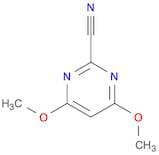
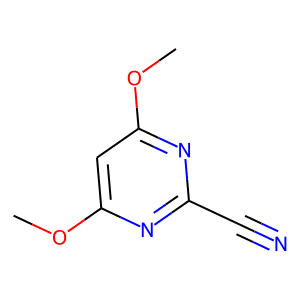
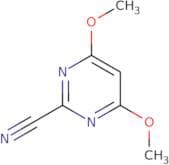
2-Cyano-4,6-dimethoxy-pyrimidine is an organic compound characterized by its pyrimidine ring structure, which is a six-membered aromatic ring containing two nitrogen atoms at positions 1 and 3. This compound features a cyano group (-C≡N) at the 2-position and two methoxy groups (-OCH₃) at the 4 and 6 positions of the pyrimidine ring. The presence of the cyano group contributes to its reactivity, making it useful in various synthetic applications, particularly in the field of medicinal chemistry and agrochemicals. The methoxy groups enhance the solubility and stability of the compound, influencing its interaction with biological systems. 2-Cyano-4,6-dimethoxy-pyrimidine is typically a crystalline solid and may exhibit moderate to high polarity due to the functional groups present. Its unique structure allows it to participate in various chemical reactions, including nucleophilic substitutions and cycloadditions, making it a valuable intermediate in the synthesis of more complex molecules. Safety data should be consulted for handling and storage, as with all chemical substances.
Formula:C7H7N3O2
InChI:InChI=1/C7H7N3O2/c1-11-6-3-7(12-2)10-5(4-8)9-6/h3H,1-2H3
SMILES:COc1cc(nc(C#N)n1)OC
Synonyms:- 2-Pyrimidinecarbonitrile, 4,6-dimethoxy-
- 4,6-Dimethoxy-2-pyrimidinecarbonitrile
- 4,6-Dimethoxypyrimidine-2-carbonitrile
- T6N Cnj Bcn Do1 Fo1 [Wln]
Sort by
Purity (%)
0
100
|
0
|
50
|
90
|
95
|
100
Found 4 products.
2-Pyrimidinecarbonitrile, 4,6-dimethoxy-
CAS:Formula:C7H7N3O2Purity:97%Color and Shape:SolidMolecular weight:165.14944,6-Dimethoxypyrimidine-2-carbonitrile
CAS:4,6-Dimethoxypyrimidine-2-carbonitrileFormula:C7H7N3O2Purity:98%Color and Shape: off-white crystalline solidMolecular weight:165.15g/mol4,6-Dimethoxypyrimidine-2-carbonitrile
CAS:Formula:C7H7N3O2Purity:95.0%Color and Shape:SolidMolecular weight:165.1524,6-Dimethoxypyrimidine-2-carbonitrile
CAS:4,6-Dimethoxypyrimidine-2-carbonitrile (DMP) is a chemical compound that belongs to the class of sulfones. It has been shown to be effective in the treatment of sulfate-reducing bacteria, such as Clostridium and Desulfovibrio. DMP is also used for the chlorination of organic compounds, such as chlorinated phenols and chlorinated benzenes. DMP can be synthesized by reacting 4,6-dimethoxybenzene with carbon disulfide and sodium hydroxide in aqueous solution.
Formula:C7H7N3O2Purity:Min. 95%Molecular weight:165.15 g/mol