CAS 13965-03-2
:Dichlorobis(triphenylphosphine)palladium
Description:
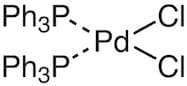
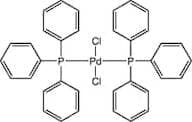
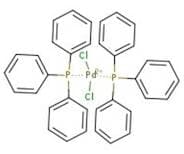
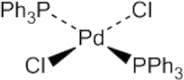
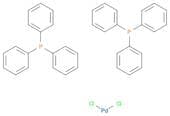
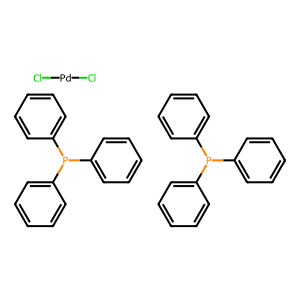
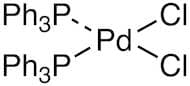
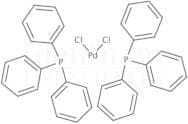
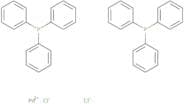
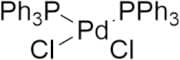
Dichlorobis(triphenylphosphine)palladium, commonly referred to as Pd(PPh₃)₂Cl₂, is a coordination complex of palladium that features two triphenylphosphine ligands and two chloride ions. This compound is characterized by its square planar geometry, typical of many d⁸ metal complexes, which contributes to its stability and reactivity. It is often used as a catalyst in various organic reactions, particularly in cross-coupling reactions such as the Suzuki and Heck reactions, due to its ability to facilitate the formation of carbon-carbon bonds. The presence of the triphenylphosphine ligands enhances the solubility of the complex in organic solvents and provides steric bulk, which can influence reaction selectivity. Pd(PPh₃)₂Cl₂ is typically handled under inert atmospheres to prevent degradation and is sensitive to moisture. Its applications extend to the synthesis of pharmaceuticals, agrochemicals, and advanced materials, making it a valuable compound in both academic and industrial chemistry.
Formula:C36H30Cl2P2Pd
InChI:InChI=1S/2C18H15P.2ClH.Pd/c2*1-4-10-16(11-5-1)19(17-12-6-2-7-13-17)18-14-8-3-9-15-18;;;/h2*1-15H;2*1H;/q;;;;+2/p-2
InChI key:InChIKey=YNHIGQDRGKUECZ-UHFFFAOYSA-L
SMILES:[P]([Pd+2]([P](C1=CC=CC=C1)(C2=CC=CC=C2)C3=CC=CC=C3)([Cl-])[Cl-])(C4=CC=CC=C4)(C5=CC=CC=C5)C6=CC=CC=C6
Synonyms:- B 1667
- Bis(triphenylphosphine)dichloropalladium
- Bis(triphenylphosphine)dichloropalladium(II)
- Bis(triphenylphosphine)palladium chloride
- Bis(triphenylphosphine)palladium dichloride
- Bis(triphenylphosphine)palladium(II) dichloride
- Bis(triphenylphosphino)-palladium(II) dichloride
- Bis(triphenylphosphino)palladium chloride
- Cis-Bis(Triphenylphosphine)Platinum(Ii) Dichloride
- Dichlorobis(Triphenylphosphine)Palladate (Ii)
- Dichlorobis(Triphenylphosphine)Palladium
- Dichlorobis(triphenylphosphin)palladium
- Dichlorobis(triphenylphosphine)palladium(II)
- Dichlorobis(triphenylphosphine)platinum (II)
- Diclorobis(Trifenilfosfina)Paladio
- Nsc 122924
- Palladium(2+) Chloride-Triphenylphosphane (1:2:2)
- Palladium, dichlorobis(triphenylphosphine)-
- Palladiumbis(triphenylphosphine) dichloride
- Phosphine, Triphenyl-, Palladium(2+) Salt, Dihydrochloride
- Trans-Dichlorobis(triphenyl-phosphine) Palladium(II)
- cis-Bis(triphenylphosphine)platinum(II) chloride
- trans-Bis(triphenylphosphine)palladium dichloride
- See more synonyms
Sort by
Purity (%)
0
100
|
0
|
50
|
90
|
95
|
100
Found 15 products.
Bis(triphenylphosphine)palladium(II) Dichloride
CAS:Formula:C36H30Cl2P2PdPurity:>98.0%(T)Color and Shape:Light yellow to Brown powder to crystalMolecular weight:701.90trans-Dichlorobis(triphenylphosphine)palladium(II), Pd 14.0% min
CAS:Hydrogenation, hydrosilation, carbonylation, oxidation, and C-C bond formationFormula:C36H30Cl2P2PdMolecular weight:701.90trans-Dichlorobis(triphenylphosphine)palladium(II), Premion™, 99.95% (metals basis), Pd 14.7% min
CAS:As a catalyst of choice in hydrogenation, hydrosilation, carbonylation, oxidation, elimination, reduction, allyl aceate isomerization, dimerization of 1,3-dienes, and C-C bond formation such as Negishi coupling, Suzuki coupling, Kumada coupling, Sonogashira coupling, Heck coupling and Sonogashira-HFormula:C36H30Cl2P2PdPurity:99.95%Molecular weight:701.90Bis(triphenylphosphine)palladium(II) dichloride
CAS:Purity:98%Color and Shape:White to yellow powder or crystalsMolecular weight:701.90trans-Dichlorobis(triphenylphosphine)palladium(II), 99% (99.9+%-Pd)
CAS:trans-Dichlorobis(triphenylphosphine)palladium(II), 99% (99.9+%-Pd)
Formula:PdCl2(P(C6H5)3Purity:(99.9+%-Pd)Color and Shape:yellow pwdr.Molecular weight:701.89Dichlorobis(triphenylphosphine)palladium
CAS:Formula:C36H30Cl2P2PdPurity:98%Color and Shape:SolidMolecular weight:701.8969Ref: IN-DA001BFX
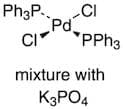
1gTo inquire5gTo inquire10gTo inquire25gTo inquire50gTo inquire100mgTo inquire250mgTo inquiretrans-Dichlorobis(triphenylphosphine)palladium(II)/potassium phosphate admixture [CatKit single-use vials - 6.32 wt% Pd complex]
CAS:trans-Dichlorobis(triphenylphosphine)palladium(II)/potassium phosphate admixture [CatKit single-use vials - 6.32 wt% Pd complex]
Formula:PdCl2P(C6H5)3K3PO4Color and Shape:off-white pwdr.Molecular weight:701.89Bis(triphenylphosphine)palladium(II) chloride
CAS:Bis(triphenylphosphine)palladium(II) chlorideFormula:·2C18H15P·Cl2PdPurity:98%Color and Shape: yellow solidMolecular weight:701.89692g/molBis(triphenylphosphine)palladium(II)chloride
CAS:Formula:C36H30Cl2P2PdColor and Shape:Yellow to gold crystalline powderMolecular weight:701.91PdCl2(PPh3)2 (HPMC encapsulated)
CAS:Formula:C36H30Cl2P2PdColor and Shape:White to Light yellow to Light orange capsuleMolecular weight:701.90Bis(Triphenylphosphine)palladium (II) chloride
CAS:Formula:C36H30Cl2P2PdPurity:98.0%Color and Shape:Solid, Crystalline Powder or PowderMolecular weight:701.9Bis(triphenylphosphine) palladium(II) chloride, 99.95% (metals basis)
CAS:Formula:(C6H5)3PPdCI2Purity:≥ 99.95%Color and Shape:Pale yellow to brown powder or crystalsMolecular weight:701.89Bis(triphenylphosphine)palladium(II) dichloride
CAS:Bis(triphenylphosphine)palladium(II) dichloride is an organometallic compound that has antibiotic activity. It is the active methylene in a number of drug molecules, including methyldopa, which is used to treat high blood pressure and postural hypotension. Bis(triphenylphosphine)palladium(II) dichloride also has potential use as a target enzyme for cross-coupling reactions. Cross-coupling reactions involve the coupling of organic compounds with organometallic reagents using palladium as a catalyst. The mechanism of this reaction involves the formation of a palladium-carbon bond by oxidative addition and reductive elimination, followed by the release of carbon monoxide. This process leads to the formation of an organometallic compound and an aryl halide. Bis(triphenylphosphine)palladium(II) dichloride can also be used in gel permeation chromFormula:C36H30Cl2P2PdPurity:Min. 95%Color and Shape:Yellow PowderMolecular weight:701.9 g/molBis(Triphenylphosphine) Palladium(II) Dichloride extrapure, 14%-15.50% Pd
CAS:Formula:C36H30Cl2P2PdMolecular weight:701.90Dichlorobis(triphenylphosphine) Palladium (II)
CAS:Controlled ProductApplications Dichlorobis(triphenylphosphine) Palladium (II) is used primarily in organometallic catalytic reactions due to the palladium content of the compound. It is also involved in crystalized structures of metallacyclic complexes which show antiinflammatory and antifungal properties.
References Paul, P. et al.: J. Organometal. Chem., 724, 281 (2013); Pandiarajan, D. et al.: J. Organometal. Chem., 708-709, 18, (2012); Shhaheen, F. et al.: J. Organometal. Chem., 693, 315 (2010);Formula:C36H30Cl2P2PdColor and Shape:NeatMolecular weight:701.89