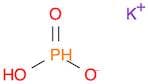
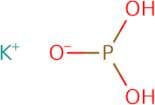
CAS 13977-65-6
:Potassium dihydrogen phosphite
Description:
Potassium dihydrogen phosphite, with the CAS number 13977-65-6, is an inorganic compound characterized by its white crystalline appearance. It is the potassium salt of phosphorous acid and is often represented by the chemical formula KH2PO3. This compound is soluble in water, making it useful in various applications, including agriculture as a fertilizer and fungicide. Its solubility allows for easy absorption by plants, promoting growth and enhancing resistance to certain diseases. Potassium dihydrogen phosphite is also known for its role in the synthesis of other phosphite compounds and can act as a reducing agent in chemical reactions. Additionally, it exhibits properties that can help in the management of plant health, particularly in combating fungal pathogens. Safety data indicates that while it is generally considered low in toxicity, appropriate handling and safety measures should be observed to prevent any adverse effects. Overall, potassium dihydrogen phosphite is valued for its agricultural benefits and its utility in various chemical processes.
Formula:H2KO3P
InChI:InChI=1/3K.O3P/c;;;1-4(2)3/q3*+1;-3
InChI key:InChIKey=NALWAAAUJRFFJI-UHFFFAOYSA-N
SMILES:P(=O)(O)O.[K]
Synonyms:- Foli-R-Fos
- Monopotassium phosphite
- Monopotassium phosphonate
- Phosphonic acid, monopotassium salt
- Phosphonic acid, potassium salt (1:1)
- Potassium phosphite (KH<sub>2</sub>PO<sub>3</sub>)
- Potassium phosphite (KH<sub>2</sub>PO<sub>4</sub>)
- Tripotassium Phosphite
- Potassium phosphite (KH2PO4)
- Phosphorous acid dihydrogen=potassium salt
- Potassium dihydrogen phosphite
Sort by
Purity (%)
0
100
|
0
|
50
|
90
|
95
|
100
Found 2 products.
Phosphonic acid, potassium salt (1:1)
CAS:Formula:H2KO3PPurity:98%Color and Shape:SolidMolecular weight:120.0861Monopotassium phosphite
CAS:Monopotassium phosphite is a toxic substance with a strong inhibitory effect on bacteria, microorganisms and autotrophs. Monopotassium phosphite is structurally similar to hypophosphite, whereas monopotassium phosphite has an additional potassium ion. It can be found in high concentrations in the cells of microalgae such as Botryococcus braunii. Monopotassium phosphite inhibits the growth of bacteria by inhibiting the transfer of phosphorus from ATP to other compounds and by altering the structure of bacterial cell membranes. Monopotassium phosphite also inhibits the growth of fungi, algae and plants that require phosphate for their metabolic processes (i.e., photosynthesis).
Formula:H2KO3PColor and Shape:PowderMolecular weight:120.09 g/molRef: 3D-FM148946
Discontinued product