CAS 1398-61-4
:Chitin
- 2-(acetylamino)-2-deoxy-beta-D-glucopyranosyl-(1->4)-2-(acetylamino)-2-deoxy-beta-D-glucopyranosyl-(1->4)-2-(acetylamino)-2-deoxy-beta-D-glucopyranose
- A-Chitin
- Acetylated chitin
- Beyond All Natural Plant Amendment
- BiNFi-s SFo 2002
- BiNFi-s SFo-10002
- BiNFi-s-SFo 20002
- BiNFi-s-SFo 20010
- C 0072
- C 7170
- C 9213
- Chitan, N-acetyl-
- Chitin L-PC
- Chitin Tc-L
- Chitine
- ChitoRem SC 20
- ChitoRem SC 80
- Clandosan
- Hy 02
- K 1262
- Kimica Chitin F
- Kimitsu Chitin
- N-[(2R,4R,5S)-2-({[(3S,4S,6R)-5-(acetylamino)-6-({[(3S,4S,6R)-5-(acetylamino)-4,6-dihydroxy-2-(hydroxymethyl)tetrahydro-2H-pyran-3-yl]methoxy}methyl)-4-hydroxy-2-(hydroxymethyl)tetrahydro-2H-pyran-3-yl]methoxy}methyl)-4,5-dihydroxy-6-(hydroxymethyl)tetrahydro-2H-pyran-3-yl]acetamide (non-preferred name)
- North Chitin CG 2
- Poly-N-acetyl-D-glucosamine
- Poly-[1-4]-b-D-N-acetylglucosamine
- Quitina
- Regitex FA
- SFo 20002
- Sec 1
- Taliderm
- Talymed
- Xjh 2858
- beta-(1,4)-2-Acetamido-2-deoxy-D-glucose
- beta-1,4-poly-N-acetyl-D-glucosamine
- poly-1-beta-4GlcNAc
- β-Chitin
- γ-Chitin
- See more synonyms
Chitin
CAS:Formula:(C8H13NO5)nColor and Shape:White to Light yellow to Light orange powder to crystalChitin, from squid, 5mm flakes
CAS:Formula:C8H13NO5nColor and Shape:Off-white, pale beige or yellow-orange fine flakesChitin, technical grade
CAS:Formula:C8H13NO5nColor and Shape:White to tan, orange or pink powder, or fine flakesChitin, fungal origin
CAS:Formula:C8H13NO5nColor and Shape:White, off-white or light-yellow powder or flakesChitin
CAS:Formula:C8H13NO5nColor and Shape:White to tan, orange or pink powderMolecular weight:[203.19]nChitin
CAS:Chitin: a structural polysaccharide in fungi cell walls, insect exoskeletons, and aquatic creature hard parts.Formula:C14H25NO9Purity:98%Color and Shape:White Amorphous Semitransparent Mass SolidMolecular weight:351.352Chitin, Practical Grade
CAS:Applications A naturally occuring fibre found in the shells of shellfish. Used for the analysis of Chitinase.
References Skujins, J.J., et al.: Arch. Biochem. Biophys., 111, 358 (1965).Formula:C24H39N3O15X2Color and Shape:NeatMolecular weight:609.58Chitin
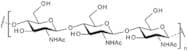
CAS:Chitin forms the tough fibrous exoskeletons of insects, crustaceans and other arthropods, and, in addition to its presence in some fungi, it occurs in at least one alga. The structure of chitin is similar to that of cellulose but with glucose replaced with N-acetyl-D-glucosaminyl units linked β-D-(1,4) in a linear chain. Chitin is normally produced from the shells of lobster, crab or shrimp.
Formula:(C8H13NO5)nColor and Shape:PowderColloidal Chitin
CAS:Chitin is a polysaccharide which is found widely in nature, where it functions in a manner similar to collagen in chordates. It forms the tough fibrous exoskeletons of insects, crustaceans and other arthropods, and, in addition to its presence in some fungi, it occurs in at least one alga. The structure of chitin is similar to that of cellulose but with glucose replaced with N-acetyl-D-glucosaminyl units linked β-D-(1,4) in a linear chain. It is normally produced from the shells of lobster, crab or shrimp.
Color and Shape:PowderChitin (Poly-(b1-4)-N-acetyl glucosamine) extrapure
CAS:Formula:(C8H13NO5)nColor and Shape:White to beige, Powder