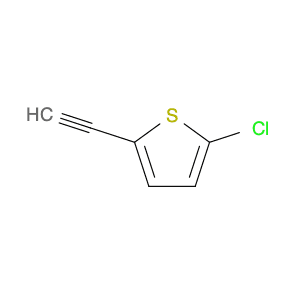
CAS 139957-82-7
:2-CHLORO-5-ETHYNYL-THIOPHENE
Description:
2-Chloro-5-ethynylthiophene is an organic compound characterized by its thiophene ring, which is a five-membered aromatic heterocycle containing sulfur. The presence of a chloro group at the second position and an ethynyl group at the fifth position contributes to its unique reactivity and properties. This compound is typically a pale yellow to brown solid and is known for its potential applications in organic electronics, particularly in the development of conductive polymers and materials for organic light-emitting diodes (OLEDs). Its structure allows for various chemical modifications, making it a versatile building block in synthetic organic chemistry. The compound's reactivity is influenced by the electron-withdrawing nature of the chloro substituent and the triple bond of the ethynyl group, which can participate in further reactions such as cross-coupling. Safety data indicates that, like many chlorinated compounds, it should be handled with care due to potential toxicity and environmental concerns. Overall, 2-chloro-5-ethynylthiophene is a significant compound in materials science and organic synthesis.
Formula:C6H3ClS
Sort by
Purity (%)
0
100
|
0
|
50
|
90
|
95
|
100
Found 3 products.
2-Chloro-5-ethynylthiophene
CAS:<p>2-Chloro-5-ethynylthiophene</p>Purity:≥95%Molecular weight:142.61g/mol2-Chloro-5-ethynylthiophene
CAS:<p>2-Chloro-5-ethynylthiophene (2CET) is a x-ray crystal structure that exhibits potent adenosine receptor antagonist activity. 2CET binds to the adenosine receptor in a noncompetitive manner and blocks the receptor, preventing the activation of G proteins. The binding of 2CET to the adenosine receptor leads to an increase in adenine nucleotide levels, which may contribute to its antihypertensive properties. 2CET has also been shown to be a potent agonist at A1 and A2A receptors. It was found that 2CET bound with high affinity to both receptors, but only activated A1 receptors. This indicates that 2CET is capable of stimulating cAMP production without activating other G protein coupled receptors such as angiotensin II type 1 or muscarinic acetylcholine receptors.</p>Formula:C6H3ClSPurity:Min. 95%Molecular weight:142.61 g/mol