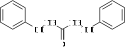
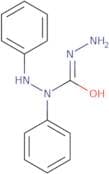
CAS 140-22-7
:sym-Diphenylcarbazide
Description:
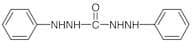
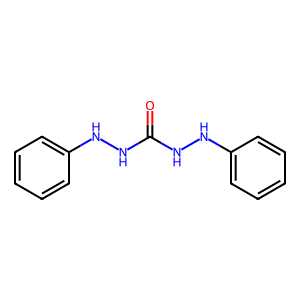
Sym-Diphenylcarbazide, with the CAS number 140-22-7, is an organic compound characterized by its structure, which features two phenyl groups attached to a central carbazide moiety. This compound is typically a solid at room temperature and is known for its use as a reagent in analytical chemistry, particularly in the detection of certain metal ions, such as mercury and lead, through colorimetric methods. Sym-Diphenylcarbazide exhibits good solubility in organic solvents, making it suitable for various applications in organic synthesis and analytical procedures. It is also recognized for its potential as a ligand in coordination chemistry. However, it is important to handle this compound with care, as it may pose health risks if ingested or inhaled, and appropriate safety measures should be taken during its use. Overall, sym-Diphenylcarbazide is valued for its chemical reactivity and utility in laboratory settings.
Formula:C13H14N4O
InChI:InChI=1/C13H14N4O/c18-13(16-14-11-7-3-1-4-8-11)17-15-12-9-5-2-6-10-12/h1-10,14-15H,(H2,16,17,18)
InChI key:InChIKey=KSPIHGBHKVISFI-UHFFFAOYSA-N
SMILES:N(NC(NNC1=CC=CC=C1)=O)C2=CC=CC=C2
Synonyms:- 1,3-Dianilinourea
- 1,5-Diphenylcarbazide
- 1,5-Diphenylcarbohydrazide
- 2,2′-Diphenylcarbazide
- 2,2′-Diphenylcarbonic dihydrazide
- Carbohydrazide, 1,5-diphenyl-
- Carbonic dihydrazide, 2,2′-diphenyl-
- Diphenylcarbazide
- N,N′-Diphenylcarbazide
- NSC 5058
- s-Diphenylcarbazide
- sym-Diphenylcarbazide
- DPC
- S-DIPHENYLCARBOHYDRAZIDE
- 2,2’-Diphenylcarbonicdihy-drazide
- 1,5-Diphenylcabohydrazide
- 2,2’-diphenyl-Carbonicdihydrazide
- 1,5-Diphenylcarbohydrazine
- 1,5-DIPHENYLCARBONOHYDRAZIDE
- TIMTEC-BB SBB008713
- 2,2’-diphenyl-carbonicdihydrazid
- SYM-DIPHENYLACARBAZIDE
- 2,2’-diphenylcarbonicdihydrazide
- 1,5-diphenyl-carbohydrazid
- See more synonyms
Sort by
Purity (%)
0
100
|
0
|
50
|
90
|
95
|
100
Found 11 products.
1,5-Diphenylcarbonohydrazide
CAS:Formula:C13H14N4OPurity:>98.0%(HPLC)Color and Shape:White to Light yellow to Light orange powder to crystalMolecular weight:242.281,5-Diphenylcarbazide, 97+%
CAS:1,5-Diphenylcarbazide is used in the colorimteric determination of chromium, osmium as well as in the detection of cadmium, mercury, magnesium, emetine and aldehydes. This Thermo Scientific Chemicals brand product was originally part of the Alfa Aesar product portfolio. Some documentation and labeFormula:C13H14N4OPurity:97+%Color and Shape:Crystals or powder or crystalline powder, White to cream or pale yellow or pale pink or pale greyMolecular weight:242.281,5-Diphenylcarbazide, ACS
CAS:1,5-Diphenylcarbazide is used in the colorimetric determination of chromium, osmium as well as in the detection of cadmium, mercury, magnesium, emetine and aldehydes. This Thermo Scientific Chemicals brand product was originally part of the Alfa Aesar product portfolio. Some documentation and labelFormula:C13H14N4OColor and Shape:White to pale cream; slowly becomes pink on exposure to air., Crystalline powder or powderMolecular weight:242.28Carbonic dihydrazide, 2,2'-diphenyl-
CAS:Formula:C13H14N4OPurity:98%Color and Shape:SolidMolecular weight:242.2765Diphenylcarbazide
CAS:Diphenylcarbazide is used for the determination of chromium.Formula:C13H14N4OPurity:98%Color and Shape:Beige PowderMolecular weight:242.281,5-Diphenylcarbazide
CAS:1,5-Diphenylcarbazide is a chemical compound that is used in analytical chemistry. It can be used to detect trace amounts of metals by using the surface methodology and potassium dichromate as a catalyst. The potassium dichromate catalyzes the reaction between methyl ethyl ketone, chromium, and copper chloride. Methyl ethyl ketone reacts with chromium to produce an unstable intermediate that decomposes into methyl ethyl and chromium oxide. This reaction produces two products: one volatile (methyl ethyl) and one non-volatile (chromium oxide). The volatile product can be detected by mass spectroscopy in plasma mass spectrometry. 1,5-Diphenylcarbazide has been shown to have a high detection sensitivity for many metals, including copper, nickel, zinc, lead, cadmium and mercury. 1,5-Diphenylcarbazide is also used in plant physiology studies to study photosFormula:C13H14N4OPurity:Min. 98 Area-%Color and Shape:PowderMolecular weight:242.28 g/mol1,5-Diphenylcarbazide ACS
CAS:Formula:C6H5NHNHCONHNHC6H5Color and Shape:White to almost white, slowely becomes pink on exposure to air, Crystalline powderMolecular weight:242.281,5-Diphenylcarbazide
CAS:1,5-Diphenylcarbazide is a versatile building block that can be used as a precursor to many other chemicals. It has been used in the research and development of pharmaceuticals, pesticides, herbicides, and fungicides. 1,5-Diphenylcarbazide is also a useful intermediate for the synthesis of organic compounds. This compound is a high-quality reagent that can be used as an effective reaction component in organic synthesis or as a scaffold molecule for drug discovery.Formula:C13H14N4OPurity:Min. 98 Area-%Molecular weight:242.28 g/molRef: 3D-J-650233
1kgTo inquire5kgTo inquire10kgTo inquire25kgTo inquire2500gTo inquire-Unit-kgkgTo inquire