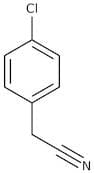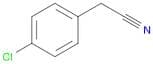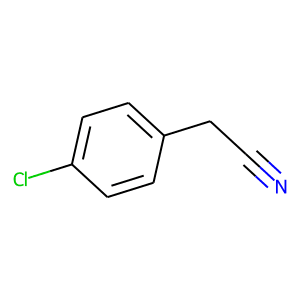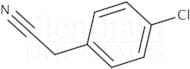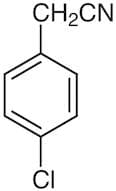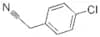
CAS 140-53-4
:(4-Chlorophenyl)acetonitrile
- (4-Chlorophenyl)Acetonitrile
- (p-Chlorophenyl)acetonitrile
- 2-(4-Chlorophenyl)acetonitrile
- 4-Chlorobenzeneacetonitrile
- 4-Chlorobenzyl nitrile
- 4-Cyanobenzylchloride
- Acetonitrile, (p-chlorophenyl)-
- Benzeneacetonitrile, 4-chloro-
- Chlorobenzylcyanide-4
- NSC 49108
- P-Chlorobenzyl Cyanide
- P-Chlorophenylacetonitrile
- Para-chlorobenzyl cyanide
- Pccn
- p-Chlorbenzylnitrile
- See more synonyms
4-Chlorophenylacetonitrile, 98+%
CAS:This Thermo Scientific Chemicals brand product was originally part of the Alfa Aesar product portfolio. Some documentation and label information may refer to the legacy brand. The original Alfa Aesar product / item code or SKU reference has not changed as a part of the brand transition to Thermo SciFormula:C8H6ClNPurity:98+%Color and Shape:Crystalline or fused solid (liquid as melt), Clear colorless or white to pale yellowMolecular weight:151.59Benzeneacetonitrile, 4-chloro-
CAS:Formula:C8H6ClNPurity:97%Color and Shape:SolidMolecular weight:151.59294-Chlorophenylacetonitrile
CAS:4-ChlorophenylacetonitrileFormula:C8H6ClNPurity:98%Color and Shape: white fused solidMolecular weight:151.59g/mol4-Chlorobenzyl Cyanide
CAS:Formula:C8H6ClNPurity:>98.0%(GC)Color and Shape:White or Colorless to Light yellow powder to lump to clear liquidMolecular weight:151.594-Chlorobenzyl Cyanide
CAS:Controlled ProductApplications 4-Chlorobenzyl Cyanide is an organic pollutant that is known to effect various aquatic organisms and species.
Not a dangerous good if item is equal to or less than 1g/ml and there is less than 100g/ml in the package
References QIn, W. C., et al.: SAR. QSAR. Enviro. Res., 21, 389 (2010); Zhang, X.J., et al.: Sci. Total. Enviro., 408, 4549 (2010);Formula:C8H6ClNColor and Shape:Colourless To Off-WhiteMolecular weight:151.594-Chlorobenzyl cyanide
CAS:4-Chlorobenzyl cyanide is a synthetic compound that has been shown to have potent antibacterial activity. This compound reacts with hydrogen chloride in the presence of isopropyl group and chloride to form 4-chlorobenzaldehyde. The reaction selectivity of this reactive chemical is due to its fluorescence properties, which can be used as a marker for detection. The introduction of hydrogen chloride into the reaction mixture produces an acidic environment, which promotes the production of chloroform. The chloroform is then removed by evaporating the water from the reaction mixture, leaving 4-chlorobenzaldehyde as a solid product.
Formula:C8H6ClNPurity:Min. 95%Color and Shape:Clear LiquidMolecular weight:151.59 g/mol