![[1,1′-Biphenyl]-4-carbonyl chloride](/_next/image/?url=https%3A%2Fstatic.cymitquimica.com%2Fcas-image%2Fthumb-webp%2F232414-11-biphenyl-4-carbonyl-chloride.webp&w=3840&q=75)
CAS 14002-51-8
:[1,1′-Biphenyl]-4-carbonyl chloride
Description:
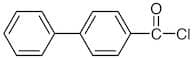
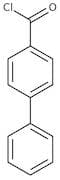
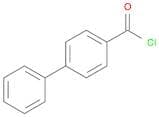
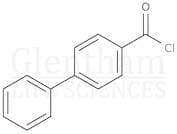
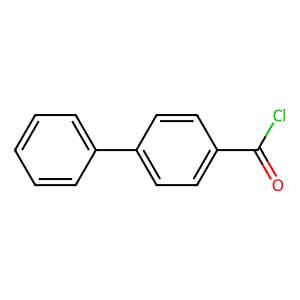
[1,1′-Biphenyl]-4-carbonyl chloride, also known as 4-biphenylcarbonyl chloride, is an organic compound characterized by the presence of a biphenyl structure with a carbonyl chloride functional group at the para position. This compound typically appears as a colorless to pale yellow liquid or solid, depending on the temperature and purity. It is known for its reactivity, particularly due to the presence of the acyl chloride functional group, which makes it a useful intermediate in organic synthesis, especially in the preparation of various pharmaceuticals and agrochemicals. The compound is generally sensitive to moisture and can hydrolyze to form the corresponding carboxylic acid. It is important to handle this substance with care, as it can be corrosive and may cause irritation upon contact with skin or mucous membranes. Proper safety measures, including the use of personal protective equipment and working in a well-ventilated area or fume hood, are essential when working with this chemical.
Formula:C13H9ClO
InChI:InChI=1S/C13H9ClO/c14-13(15)12-8-6-11(7-9-12)10-4-2-1-3-5-10/h1-9H
InChI key:InChIKey=JPVUWCPKMYXOKW-UHFFFAOYSA-N
SMILES:C(Cl)(=O)C1=CC=C(C=C1)C2=CC=CC=C2
Synonyms:- (1R)-1-(4-tert-butylphenyl)ethanamine
- 4-(Phen-4-yl)benzoyl chloride
- 4-Biphenylylformyl chloride
- 4-Phenylbenzoyl chloride
- Biphenyl-4-Carbonyl Chloride
- Biphenyl-4-carboxylchloride
- Bisphenyl-4-carbony chloride
- Diphenyl-4-carboxylic acid chloride
- [1,1′-Biphenyl]-4-carbonyl chloride
- p-Biphenylcarbonyl chloride
- p-Phenylbenzoyl chloride
- See more synonyms
Sort by
Purity (%)
0
100
|
0
|
50
|
90
|
95
|
100
Found 7 products.
4-Phenylbenzoyl Chloride
CAS:Formula:C13H9ClOPurity:>98.0%(GC)(T)Color and Shape:White to Almost white powder to crystalMolecular weight:216.66Biphenyl-4-carbonyl chloride, 98%
CAS:Biphenyl-4-carbonyl chloride was used in the preparation of a novel thiourea compound, N-(6-methyl pyridin-2-yl-carbamothioyl)biphenyl-4-carboxamide. It was also used in the preparation of 5-CF3-oxazole analog, 2-{4-[2-(2-biphenyl-4-yl-5-trifluoromethyl-oxazol-4-yl)-ethoxy]-phenoxy}-2-methyl-propionFormula:C13H9ClOPurity:98%Color and Shape:White to cream or pale yellow to yellow or pale cream with grey, Crystals or powder or crystalline powder or lumpy powderMolecular weight:216.664-Biphenylcarbonyl chloride
CAS:Formula:C13H9ClOPurity:98%Color and Shape:SolidMolecular weight:216.6630Biphenyl-4-carbonyl chloride
CAS:Formula:C13H9ClOPurity:≥ 97.0%Color and Shape:White to yellow or beige, powder or solidMolecular weight:216.66Biphenyl-4-carbonyl chloride
CAS:Biphenyl-4-carbonyl chlorideFormula:C13H9ClOPurity:93%Color and Shape: white crystalline solidMolecular weight:216.66g/mol4-Biphenylcarbonyl chloride
CAS:Formula:C13H9ClOPurity:98%Color and Shape:SolidMolecular weight:216.664-Phenylbenzoyl chloride
CAS:4-Phenylbenzoyl chloride is a primary amino compound that has been studied extensively in the context of biological studies and as an electroluminescent device. It is also used to study the effects of alkylation on biological systems. 4-Phenylbenzoyl chloride has been shown to be cytotoxic against monocytic cell lines, with a mechanism of action that involves its ability to react with DNA, forming adducts that interfere with DNA replication. In addition, it also reacts with amines in human tissue samples, which may lead to carcinogenic effects. This compound is also effective against protozoan parasites and Leishmania species, although not thiosemicarbazide.
Formula:C13H9ClOPurity:Min. 95%Color and Shape:PowderMolecular weight:216.66 g/mol