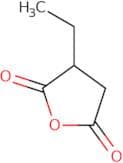
CAS 14035-81-5
:3-ethyloxolane-2,5-dione
Description:
3-Ethyloxolane-2,5-dione, also known as ethyl 2,5-dioxotetrahydrofuran-3-carboxylate, is a cyclic compound characterized by its five-membered ring structure containing two carbonyl (C=O) groups and an ethyl substituent. This compound typically exhibits a colorless to pale yellow appearance and is soluble in organic solvents. Its molecular structure contributes to its reactivity, particularly in nucleophilic addition reactions due to the electrophilic nature of the carbonyl groups. The presence of the ethyl group enhances its lipophilicity, making it more soluble in non-polar solvents. 3-Ethyloxolane-2,5-dione can be synthesized through various organic reactions, often involving the cyclization of appropriate precursors. It may find applications in organic synthesis, particularly in the preparation of more complex molecules, and could serve as an intermediate in the production of pharmaceuticals or agrochemicals. As with many chemical substances, handling should be done with care, considering potential hazards and safety protocols.
Formula:C6H8O3
InChI:InChI=1/C6H8O3/c1-2-4-3-5(7)9-6(4)8/h4H,2-3H2,1H3
Synonyms:- Dihydro-3-ethyl-2,5-furandione
- 3-ethyldihydrofuran-2,5-dione
Sort by
Purity (%)
0
100
|
0
|
50
|
90
|
95
|
100
Found 1 products.
3-Ethyloxolane-2,5-dione
CAS:3-Ethyloxolane-2,5-dione is a polymerization initiator that is used in the production of polymers and sealants. Its main application is for the production of polycarboxylic acid ester resins, which are monosubstituted with an ethyloxolane group. 3-Ethyloxolane-2,5-dione reacts with aluminium chloride to form a hydrochloric acid salt. This polymerization initiator also reacts with hydrogen chloride to form a monomer that is soluble in organic solvents. It has been shown to be biodegradable and not toxic to humans or animals at low doses.
Formula:C6H8O3Purity:Min. 95%Molecular weight:128.13 g/mol